


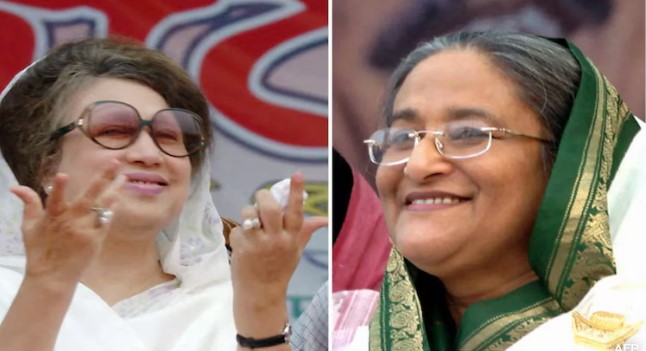
Zia's supporters saw her as polite and traditional, yet a stylish force, someone who chose her words carefully. But they also viewed her as a bold, uncompromising leader when it came to defending her party and confronting her rivals.
Khaleda Zia, who became Bangladesh's first female prime minister in 1991, died on Tuesday after a long illness at the age of 80. The Bangladesh Nationalist Party (BNP) boss was one of two women who had dominated Bangladeshi politics for the past four decades. The other is Sheikh Hasina, a five-time prime minister who was ousted from power in August 2024 amid violent student-led protests.
Awami League Chairperson Sheikh Hasina expressed condolences on the passing of Zia.
"I extend my deepest condolences on the passing of BNP Chairperson and former Prime Minister Begum Khaleda Zia. As the first woman Prime Minister of Bangladesh, and for her role in the struggle to establish democracy, her contributions to the nation were significant and will be remembered," she said in a post by her party's Facebook page.
"Her passing represents a profound loss for Bangladesh's political life and for the leadership of the Bangladesh Nationalist Party. I pray for the eternal peace and forgiveness of Begum Khaleda Zia's soul. I convey my sincere sympathies to her son, Tarique Rahman, and to the members of her bereaved family. I also extend my condolences to the wider BNP family. I hope that Almighty Allah grants them patience, strength, and comfort to endure this difficult time," she added.
Since the 1980s, Bangladesh's politics have been defined by the bitter rivalry between Zia and Hasina -- a feud dubbed the "Battle of the Begums", an honorific title for a powerful woman. Their contest went far beyond electoral competition, as it seeped into state institutions, fuelled street violence, paralysed governance, and hollowed out democratic politics.
Zia's supporters saw her as polite and traditional, yet a stylish force, someone who chose her words carefully. But they also viewed her as a bold, uncompromising leader when it came to defending her party and confronting her rivals. Hasina, on the other hand, was far more outspoken and assertive.
The hatred between the two women could be traced back to 1975, when Hasina's father, Bangladesh's founding father and head of the Awami League party, Sheikh Mujibur Rahman, along with most of her family, was assassinated in a coup. Three months later, Zia's husband, Ziaur Rahman, then deputy army chief, effectively took control of the country and became president in 1977.
Rahman was himself assassinated in 1981. Zia, then a 35-year-old mother of two, inherited the BNP leadership. She was initially dismissed as a political novice. But she joined hands with Hasina to lead a popular uprising for democracy that toppled military ruler Hossain Mohammad Ershad in 1990, proving to be a formidable opponent.
But Zia and Hasina's cooperation did not last long. In 1991, Bangladesh held what was hailed as its first free election. Zia won a surprise victory over Hasina, having gained the support of the country's largest Islamic party, Jamaat-e-Islami.
In doing so, Khaleda became Bangladesh's first female prime minister and only the second woman to lead a democratic government of a mainly Muslim nation after Benazir Bhutto, elected to lead Pakistan three years earlier.
She went on to replace the presidential system with a parliamentary one so that power rested with the prime minister. Over the next decade and a half, the two women alternated in power in Bangladesh.
Zia lost to Hasina in the 1996 general election but came back five years later with a surprise landslide win.
But her second term was marred by the rise of Islamist militants and allegations of corruption. While she was admired for her resolve, she faced criticism for her refusal to compromise, which often left her isolated, domestically and internationally.
In 2004, a rally that Hasina was addressing was hit by grenades. Hasina survived, but over 20 people were killed, and more than 500 were wounded. Zia's government and its Islamic allies were widely blamed.
Their intractable rivalry fuelled crises, including the January 2007 standoff that brought military-backed emergency rule. Hasina later dominated, ruling Bangladesh from 2008 until her violent downfall in 2024.
With Hasina exiled in India and her Awami League banned from contesting polls, Zia was expected to lead her nation one last time after the elections next year.


comments


Other categories
Recent Comments