


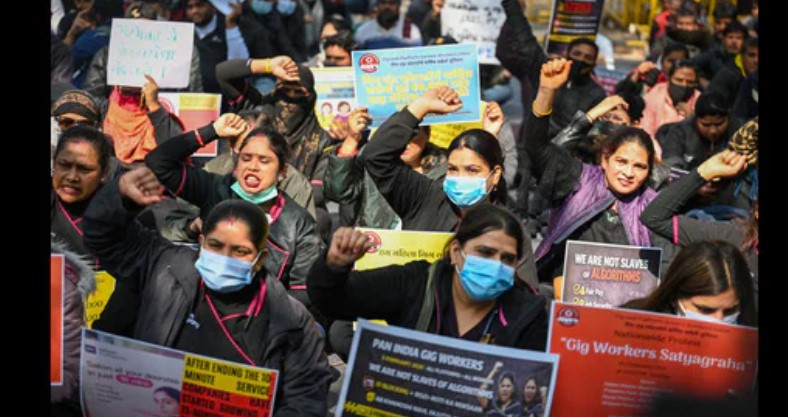
Tuesday’s protest organised in major cities in India, including Mumbai and Bengaluru, is part of a broader digital and physical protest against online platform-based companies that has beengoing since last year.
At least 70 gig workers on Tuesday gathered at the Jantar Mantar in New Delhi as part a nationwide protest against against app-based companies, demanding better social security benefits.
At the protest, organised by Gig & Platform Service Workers Union (GIPSWU), the workers held up various signs, such as “We are not slaves of algorithms” and “Unblock our IDs, unlock our lives”. They flagged concerns like arbitrary ID blocking, fluctuating wages, exploitative working hours, and lack of grievance redressal mechanisms.
Tuesday’s protest organised in major cities in India, including Mumbai and Bengaluru, is part of a broader digital and physical protest against online platform-based companies that has beengoing since last year.
Many of the protesters were women, who told HT that their jobs, which they had begun on the side, had turned into a full-time roles without their consent or a proper pay.
A 35-year-old Noida resident said she had joined as a roving beautician for Urban Company in 2021. As a single mother with two children, in the beginning it gave her a better pay and more flexibility. “I used to work in a parlour and made around ₹7,000-8,000 a month. But just a month after joining the Urban Company, my income more than tripled. Even after paying the travel expenses and cost of beauty products, I used to have around ₹35,000 in my hand.”
But, as the company grew rapidly and more employees came on board, things have changed with her in-hand earnings having reduced. “In the case of bundle booking (where more two services are clubbed together), if the total service charge is ₹ 2,900 and the company used to take ₹700 as commission and, after paying for products, hygiene kit and travel expenses, we used to have ₹1,200-1,500 in our pocket. But now if the company gives ₹900 discount on ₹2,900 services, I still take ₹700 as commission, reducing our in-hand earning to ₹700-1,000,” she added.
HT reached out to the Urban Company for a comment on these complaints but did not receive any response till the time of publication.
Others said they are required to meet multiple strict performance metrics to avoid permanent ID blocking. These include working 70–80 hours over the past four weekends, maintaining an 80% product score, a 4.8 customer rating, and keeping cancellations to a maximum of three. Once the three-cancellation limit is breached, there is no time window for recovery. Workers must complete 50 services without cancelling a single booking to remove just one cancelled order, failing which their ID is permanently blocked.
All the products we purchase and use are prescribed by the company and come with a barcode. During every service, we are required to scan the product and upload its image. However, while cleaning the products, the barcode sometimes gets partially damaged or removed due to wet hands. When this happens, we are unable to scan the product, which prevents us from using it and negatively impacts our product score by up to 80%,” explained a 42-year-old beautician from Dwarka.
Another Noida-based worker said the company doesn’t take into account unforeseen circumstances like rainfall, traffic, or delays caused by the customer.
Recalling one such instance, she said, “I went for a two-hour booking for facial and waxing. The customer, who was from the IT sector and was working from home, had asked me to wait for sometime as she had a meeting. That sometimes lasted for nearly one-and-a-half hours. It took me 3:30 hours in that order. I couldn’t cancel or ask the customer to hurry up because both would land me in trouble”.
The workers also complained that when they had joined the platform few years back, they would usually get at least 2-3 hours of buffer time between two bookings which has now gone down to 30 minutes.
Commenting on the issue, the Indian Federation of Trade Unions (IFTU) president Aparna said, based on the kind of control the app-based companies exercise on its workers, they should be regulated under employer-employee relations.
“If one is working for a company for 10-12 hours a day, and almost all days of the week, it should be considered a regular job and all regulations that apply to a normal employer-employee relationship should be considered here as well,” Aparna said.


comments


Other categories
Recent Comments