


Neither the ministry of external affairs, nor the commerce ministry, nor the Kremlin has provided any clarity on US assertions on India's Russian oil purchases.
US President Donald Trump and Prime Minister Narendra Modi announced the long-awaited trade deal between India and the United States last week, with the former claiming that New Delhi would stop purchasing Russian oil as part of the pact. In fact, Trump also removed the 25 per cent tariff he imposed on India over its energy purchases from Russia.However, the question remains. Has India stopped buying Russian oil? Or will it halt purchases? Neither New Delhi nor Washington has provided any clarity on the matter. Remarks from Russia over the same have also remained unclear.
What Trump said about Russia oil
On February 2, Donald Trump said he had spoken with PM Modi, adding that the two leaders agreed to a trade deal, under which the US will reduce India's tariffs from 25 per cent to 18 per cent.
Trump also claimed in his Truth Social post that PM Modi "agreed to stop buying Russian oil, and to buy much more from the United States and, potentially, Venezuela".
The US President said that PM Modi also committed to "BUY AMERICAN", at a much higher level, in addition to over $500 billion in US energy, technology, agriculture and coal.
"Our relationship with India will be even stronger going forward. Prime Minister Modi and I are two people that GET THINGS DONE, something that cannot be said for most," Trump wrote.
On Friday, Trump signed an executive order that eliminates the 25 per cent penalty tariff imposed on India for its Russian energy purchases.
In his executive order, Trump reiterated the claim that India would stop purchasing oil from Russia.
“Specifically, India has committed to stop directly or indirectly importing Russian Federation oil, has represented that it will purchase United States energy products from the United States, and has recently committed to a framework with the United States to expand defense cooperation over the next 10 years,” the executive order read.
The order added that India had taken "significant steps" to address US concerns on Russian oil purchases and to “align sufficiently with the United States on national security, foreign policy and economic matters”.
The executive order also put into place a monitoring mechanism, in which US Secretary of Commerce Howard Lutnick will seek to confirm if New Delhi has ceased energy purchases from Russia.
It added that if Lutnick finds that India has resumed direct or indirect importing of Russian energy, then, in accordance with his team's recommendations, Trump could reimpose the additional 25 per cent tariff as a penalty on Indian goods.
The White House on Saturday released a US-India joint statement on the 'interim' trade agreement. However, it carried no mention of India's Russian oil purchases.
What India said about Russia purchases
In the first remarks after Trump's claim that India would stop purchasing Russian oil under the trade pact with the US, the ministry of external affairs stated that India will continue to place its 1.4 billion population as a top priority, especially in the current international dynamics in the energy sector.
"In so far as India's energy security or sourcing is confirmed, the government has publicly, on several occasions, including me here, said that ensuring the energy security of 1.4 billion is the supreme priority of the government," MEA spokesperson Randhir Jaiswal said during a press conference.
“Diversifying our energy sourcing in keeping with objective market conditions and evolving international dynamics is at the core of our strategy to ensure this. All of India's decisions are taken and will be taken with this in mind,” he added further.
HT earlier reported that there are no immediate indications of India taking Russian energy purchases to zero despite a recent reduction in the volume of Russian oil imports.
India reportedly imported 1.215 million barrels per day (bpd) of Russian crude in January, with the Nayara refinery -- owned jointly by Rosneft and an investment consortium -- accounting for 0.41 million bpd, Reuters reported.
India's Russian oil imports in January were down by 12 per cent on a daily basis from December, after being down in December by almost 22 per cent from November.
Import levels of 2 million bpd were last witnessed in mid-2025. JP Morgan said in a note, "Our base case is that India will largely exit from sanctioned counterparties, but will maintain Russian imports at around 0.8–1.0 million bpd, accounting for 17–21% of total crude imports."
Once again, on Saturday, India neither confirmed nor denied the Trump administration's claims that New Delhi has committed to stop buying Russian oil as part of the trade agreement.
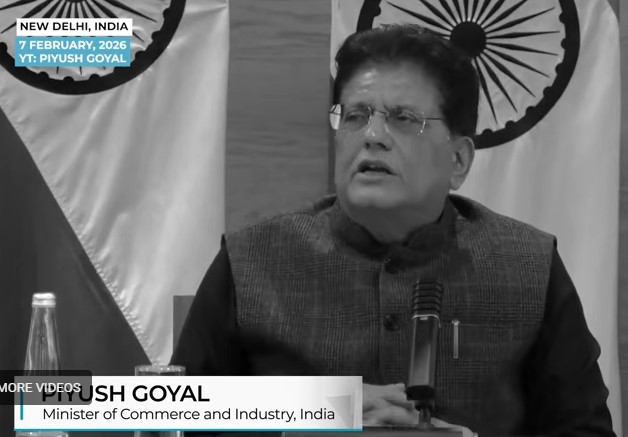
Commerce minister Piyush Goyal responded to a question about the US assertions on India and its Russian oil purchases, saying that MEA could provide information on this matter.
Subsequently, MEA spokesperson Randhir Jaiswal reiterated a statement from earlier that the "supreme priority" in sourcing energy is protecting the energy security of 1.4 billion citizens.
On Sunday, Goyal again dodged a direct answer about Trump's claims on India's Russian oil purchases. "The buying of crude oil or LNG, LPG from the US is in India's own strategic interests as we diversify our oil sources," the commerce minister said.
In an interview with news agency ANI, Goyal was asked, 'If there is a lack of bilateral consensus on Russian oil or defence matters, doesn't that impact the trade deal too?'
"No, not at all," responded Goyal. He said the deal anyway won't discuss who will buy what and from where. “The trade deal ensures that the pathway to trade is smooth, ensures preferential access. FTAs (free trade agreements) are all about preferential access… When we've got an 18% reciprocal tariff, we have a preference over other developing nations who are usually our competition,” he added.
What did Russia say?
A day after the announcement of the India-US trade deal and Trump's assertion that New Delhi would no longer purchase Russian oil, the Kremlin stated that it had heard nothing of the sort from India as of yet.
Kremlin spokesman Dmitry Peskov told reporters, "So far, we haven't heard any statements from New Delhi on this matter," AFP quoted him as saying.
Peskov further noted that Russia valued its relationship with India and would continue to develop its strategic partnership. "We respect bilateral US-Indian relations. But we attach no less importance to the development of an advanced strategic partnership between Russia and India. This is the most important thing for us, and we intend to further develop our bilateral relations with Delhi," he added.
Two days later, in fresh remarks, Peskov said the Kremlin is aware that Russia is not the only supplier of energy products to India, adding that New Delhi is free to buy oil from any country."We, along with all other international energy experts, are well aware that Russia is not the only supplier of oil and petroleum products to India. India has always purchased these products from other countries. Therefore, we see nothing new here," Peskov reportedly said.
Meanwhile, Russia's foreign ministry spokesperson Maria Zakharova said the country has no reason to believe that India would make this move, i.e., halt Russian oil purchases.
She said that US President Donald Trump was trying to "dictate" what an independent country should do, adding that Russia didn't believe its "Indian friends" had changed their approach on energy ties with Moscow.
“The US President trying to dictate who an independent nation like India can trade with is not new. Russia has no reason to believe our Indian friends have changed their approach,” Zakharova said. She further noted that trade of resources was beneficial to both India and Russia.
"We remain convinced that India's purchase of Russian hydrocarbons is beneficial to both countries and contributes to maintaining stability in the international energy market. We are ready to continue close cooperation in this area with our partners in India," she added.


comments


Other categories
Recent Comments