


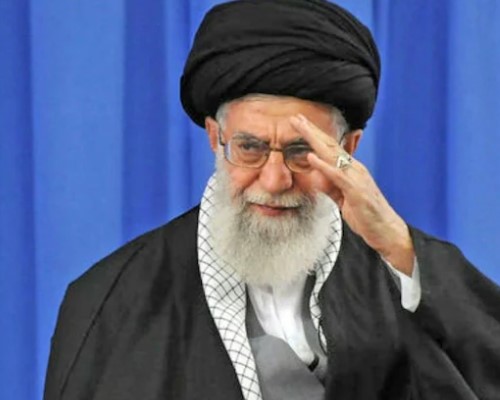
Khamenei's absence comes as tensions between Tehran and Washington have escalated, with the US expanding its military presence in the region and fears of a potential US military strike looming over the Islamic Republic.
Tehran:
Amid increasing US military buildup in the Gulf, Iran's Supreme Leader Ayatollah Ali Khamenei has reportedly broken his 37-year-old tradition by missing the annual February 8 meeting with air force commanders. Khamenei has attended the annual meeting every year since assuming leadership in 1989-- even during the COVID-19 pandemic, according to a report by Iran International.
The annual meeting marks the anniversary of February 8, 1979, when a group of air force officers pledged allegiance to Ruhollah Khomeini to overthrow the Pahlavi dynasty. Khomeini was the founder of the Islamic Republic and Khamenei's predecessor as Supreme Leader.
Over the next four decades, the day became a symbolic event, with air force personnel and commanders meeting Iran's clerical leadership on the same date each year. The report said that this year, instead of Khamenei, the chief of staff of the armed forces, Abdolrahim Mousavi, met with the army air force commanders on Sunday.
Tension With US
Khamenei's absence comes as tensions between Tehran and Washington have escalated, with the US expanding its military presence in the region and fears of a potential US military strike looming over the Islamic Republic.
Tehran has repeatedly warned that any US attack on Iran would spark a broader conflict across the Middle East, saying, "If the US initiates a war this time, it would spill over across the entire region." He was referring to the 12-day Iran-Israel war in mid-June 2025.
Even after the ceasefire, Iran and the US remain at odds over Washington's insistence that negotiations include Tehran's missile arsenal and Iran's vow to discuss only its nuclear programme, in a standoff that has led to mutual threats of airstrikes. Differences over the scope of discussions have raised doubts, leaving open the possibility that Trump could carry out a threat to strike Iran.
The US sent its aircraft carrier, the USS Abraham Lincoln, to the Arabian Sea at the end of January amid increasing tensions with Iran. Last week, the BBC reported that a dozen F-15 fighter jets, an MQ-9 Reaper combat drone, and several A-10C Thunderbolt II ground attack aircraft had arrived at Muwaffaq Salti Air Base in Jordan.
The British publication said it analysed satellite imagery that showed the guided-missile destroyer ship, USS Delbert D Black, was sailing through the Suez Canal in Egypt from the Mediterranean to the Red Sea, and a US Navy MQ-4C Triton surveillance drone was operating over the Gulf. The presence of an E-11A communications aircraft, P-8 Poseidon and E-3G Sentry surveillance and reconnaissance planes was also reported in the region earlier.


comments


Other categories
Recent Comments