


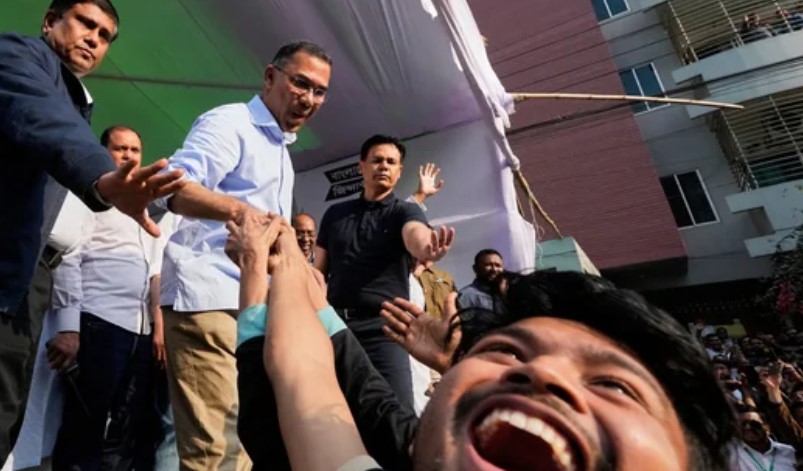
Tarique Rahman’s return to Bangladesh on December 25, 2025, was nothing short of cinematic; he was accompanied by his ginger cat, who is a viral sensation too
Long overshadowed by the towering legacies of his parents and having spent nearly two decades in the political wilderness of London after grave corruption charges forced him out of Dhaka, Tarique Rahman has finally stepped into the centre of the Bangladeshi stage.At 60, the chairman of the Bangladesh Nationalist Party (BNP) is poised to become the next prime minister of a nation of 170 million people following a sweeping victory in the first parliamentary elections since the ouster of Sheikh Hasina, who is now in self-exile in India.
His ascent marks a dramatic turnaround for a man once labeled by US diplomats as a "symbol of kleptocratic government" and a "flawed heir apparent".
Today, as he prepares to lead a country still reeling from the 2024 student-led uprising that toppled the 15-year "iron-fisted" regime of Sheikh Hasina, the question remains: is Rahman the face of a reformed, democratic Bangladesh, or a new chapter in the dynastic rivalries of many decades?
Rahman’s return to Bangladesh on December 25, 2025, was nothing short of cinematic.After 17 years in self-imposed exile, he arrived in Dhaka accompanied by his ginger cat, Zebu (usually called ‘Jebu’ by Bangla speakers), whose images quickly went viral on social media. The cat now has several Facebook pages in her name.
The joy of homecoming was largely eclipsed by the death of his mother, the three-time former PM Khaleda Zia, who passed away aged 80 just a week after his return.
Speaking from his office beneath gold-framed portraits of his late parents, Rahman described the "mixed feelings" of that moment. "This is my country, I was born here, I was raised here — so naturally, that was a very happy feeling," he told reporters. He lamented the missed opportunity to see his mother one last time: “When you come home after so long, any son wants to hug his mother... I didn't have that chance.”
Rahman then assumed the chairmanship of the BNP on January 9, 2026, and plunged into an election campaign that focused on moving past the bitterness of the Hasina era.
Bloody legacy of blood and power games
Rahman’s life has been defined by the blood-soaked history of Bangladeshi politics.
Born in 1965, he was in his mid-teens when his father, President Ziaur Rahman, a 1971 Liberation War hero and the founder of the BNP, was assassinated in a 1981 coup attempt.
During the 1971 war that turned a poor-cousin East Pakistan into a free Bangladesh, Tarique Rahman was briefly detained as a child, an experience that led his party to later hail him as "one of the youngest prisoners of war".
His father Ziaur Rehman, a military officer, had got political power in the years after Sheikh Mujibur Rahman, widely considered the founding father of Bangladesh, was assassinated by some military men in 1975 amid his dictatorial turn.
That brought Mujibur Rahman's daughter Sheikh Hasina into politics. Khaleda Zia entered politics in the 1980s after husband Ziaur Rehman's kiling.
Tarique, who often used the surname Zia, grew up in the political orbit of his mother Khaleda Zia as she engaged in a decades-long, bitter duel for power with Sheikh Hasina.
A young Rahman began his own political career in 1988 as a primary member of the BNP in Bogra. He rose to prominence during his mother’s 2001–2006 tenure as PM, a period that would also eventually lead to his downfall and exile.
Years of controversy for ‘Khamba Tarique’
To his critics, Tarique Rahman was once known as the ‘Dark Prince’ or "Khamba Tarique", the latter a derogatory nickname stemming from allegations of large-scale corruption in the power sector involving the procurement of electric poles ("khamba") at inflated prices.
The BNP's office under him was frequently accused of acting as a parallel power center where government contracts were influenced in exchange for bribes.
US embassy's diplomatic cables from the 2006–09 period, made public by WikiLeaks, stated that Rahman “inspires few but unnerves many”, characterising him as “phenomenally corrupt”.
In 2007, during a military-backed caretaker government’s anti-graft sweep, Rahman was arrested and, by his own account, tortured in custody. Facing multiple charges including money laundering and a life sentence related to a 2004 grenade attack on an Awami League rally, he left for London in 2008 on the promise that he would not engage in politics.
From London, Rahman managed the BNP as its senior vice-chairman and later as acting chairman after his mother’s imprisonment in the Hasina era in 2018. For years, he dismissed the legal cases against him as "politically motivated false charges".
mage botox for same old face
The fall of Sheikh Hasina in July-August 2024 after student-led protests opened the door for Tarique Rahman’s legal and political comeback.
In late 2024 and early 2025, Bangladeshi courts, citing procedural irregularities and lack of evidence, began overturning his convictions. Most notably, he was acquitted of the life sentence in the 2004 grenade attack case and cleared of money laundering charges.
Older and on the brink of power, he has since struck a notably conciliatory tone, perhaps aware that the Gen-Z voters who led the 2024 uprising are weary of dynastic corruption. In his party’s ‘Bangladesh Before All’ manifesto, Rahman pledged an era of “clean politics”.
“The BNP believes not in revenge, but in a politics of justice and humanity,” Rahman said ahead of the February 12 election. "The rights of the people, not power, are at the core of our politics. Production, not plunder; rights, not fear; fairness, not discrimination — these are the principles that will guide the governance of the state," he said.
In an interview with AFP, he even offered a rare, if vague, apology for the past: “If there are any mistakes which were unwanted, we are sorry for that.”
On the legacy of his parents, he was diplomatically distant: “They are them, I am me... I will try to do better than them.”
Geopolitical balancing act ahead
Tarique Rahman also inherits a complex diplomatic landscape. India, which maintained a close-to-Hasina policy for 15 years, has been forced to reset its relationship with the BNP. External affairs minister S Jaishankar has already met with Rahman in Dhaka, handing him a personal letter from Prime Minister Narendra Modi and expressing optimism for a "new chapter" in ties.
However, the BNP under Rahman has indicated it will not grant any neighbor “privileged status”, instead pushing for "equality, fairness, pragmatism, and mutual interest".
While India remains an indispensable partner due to geography, Tarique Rahman's government may look to diversify its allies, particularly given China's significant infrastructure investments and a recent thawing of ties with Pakistan.
Return to democracy with and beyond Tarique
The new PM will lead a nation where nearly 44% of voters are under the age of 37.
The 2026 election also saw a referendum introducing a 10-year cap on the Prime Minister’s tenures, a reform aimed at preventing the kind of authoritarianism that defined the Hasina years.
Whether Tarique Rahman will adhere to the spirit of these reforms or fall back into the "clan-driven politics" of the past remains a central tension of his upcoming premiership, analysts say.


comments


Other categories
Recent Comments