


Life’s genetic blueprint isn’t born in chaos—it’s built in 3D with precision from the very first moments.
For many years, researchers believed that the DNA inside a newly fertilized egg began as a structural ‘blank slate’ – a loose, unorganized mass that would only take shape once the embryo started using its own genes. In this view, order emerged only after the genetic program switched on.
New findings published today (February 24) in Nature Genetics challenge that assumption. Professor Juanma Vaquerizas and his team report that the genome is far more organized at the very beginning than previously thought. They developed a powerful new method called Pico-C that allows scientists to examine the 3D structure of the genome in extraordinary detail. With this tool, the researchers found that long before the genome fully activates – a milestone known as Zygotic Genome Activation – an intricate 3D DNA scaffold is already forming. The way DNA folds in three dimensions is critical because it determines which genes can be turned on during development, ensuring cells work properly and reducing the risk of developmental disorders and disease.
“We used to think of the time before the genome awakens as a period of chaos,” explains Noura Maziak, lead author of the study. “But by zooming in closer than ever before, we can see that it’s actually a highly disciplined construction site. The scaffolding of the genome is being erected in a precise, modular way, long before the ‘on’ switch is fully flipped.”
Mapping the 3D Genome With Pico-C
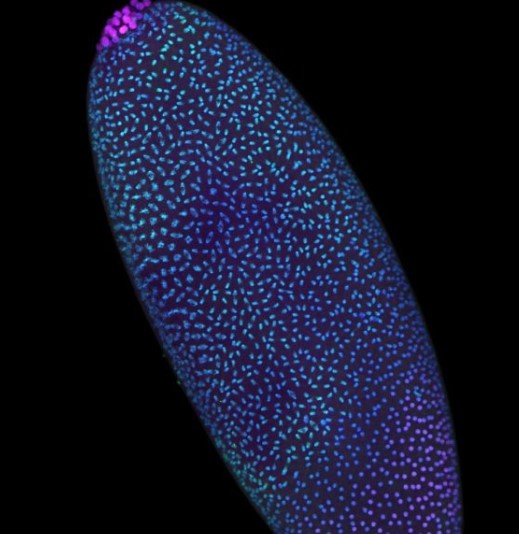
The discovery was made using the fruit fly (Drosophila), a classic model organism in genetics. In the first hours after fertilization, a fruit fly embryo rapidly divides its nuclei, producing thousands of cells in a short time. This fast-paced developmental window makes it especially useful for studying how genomes are organized and regulated.
Using their ultra-sensitive Pico-C technique, the team charted the 3D arrangement of the fruit fly genome during these earliest stages. They found that DNA does not fold randomly. Instead, it forms loops and structures that follow a modular design, allowing specific regulatory signals to control distinct regions of the genome. This carefully arranged architecture ensures that genetic instructions are primed and ready to be activated at exactly the right moment.
In addition to delivering highly detailed 3D maps of DNA shape, Pico-C requires far smaller samples than conventional approaches – about ten times less material. This efficiency opens new possibilities for investigating how DNA folding influences gene regulation and how disruptions in this architecture may contribute to disease.
From Fruit Flies to Human Health
Although this genomic “blueprint” was first identified in fruit flies, its significance extends directly to human biology. In a companion study published in Nature Cell Biology, led by Professor Ulrike Kutay and colleagues at ETH Zürich in Switzerland, researchers applied the same high-resolution mapping approach to human cells.
They examined what happens when the molecular “anchors” that stabilize the genome’s 3D structure are removed. The outcome was dramatic. When this structural framework breaks down, human cells interpret the disruption as if they are under viral attack. This false alarm activates the innate immune system, potentially driving inflammation and disease.
“These two studies tell a complete story,” says Juanma. “The first shows us how the genome’s 3D structure is carefully built at the start of life. The second shows us the disastrous consequences for human health if that structure is allowed to collapse.”


comments


Other categories
Recent Comments