


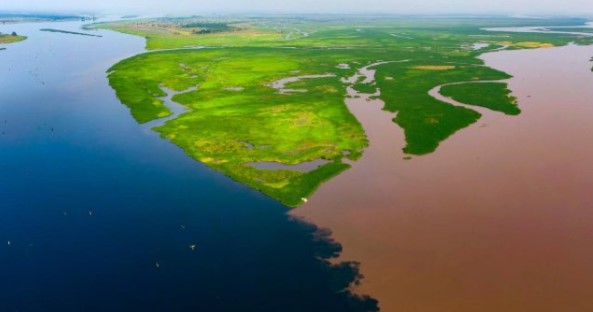
A vast African peatland once thought stable is now leaking carbon thousands of years old.
Tropical swamps and peatlands are major components of Earth’s carbon system and play a significant role in regulating the climate. Regions such as the Amazon Basin, the Congo Basin, and the wetlands of Southeast Asia steadily build up thick layers of partially decomposed plant material. Over time, these landscapes trap enormous amounts of carbon, storing an estimated 100 gigatonnes in total.
In Central Africa, the Congo Basin contains one of the largest and most important of these carbon reserves. While its peatlands and swamps make up only 0.3 percent of the Earth’s land surface, they hold roughly one third of all carbon stored in tropical peatlands.
Despite their global importance, these ecosystems remain understudied. Much of the central Congo Basin is difficult to access, and travel to remote lakes and swamps often depends on boats or traditional pirogues. This remoteness has limited scientific understanding of how strongly these peatlands influence the global carbon cycle and climate.
Congo Basin Blackwater Lakes Reveal Surprises
Over the past decade, researchers led by ETH Zurich have conducted extensive fieldwork in the Congo Basin. Their investigations have already uncovered unexpected features, including the Ruki River, one of the darkest blackwater rivers in the world.
In a new study published in Nature Geoscience, the team focused on two darkly stained lakes shaped by organic runoff from surrounding forests: Lac Mai Ndombe, Africa’s largest blackwater lake, and its smaller neighbor, Lac Tumba. Once again, the findings were surprising.
Lac Mai Ndombe covers an area more than four times the size of Lake Constance. Its waters resemble strong black tea due to dissolved organic material washed in from nearby swamp forests and largely untouched lowland rainforest growing on deep peat soils. As plant debris and soil matter break down and flow into the lake, they give the water its rich brown color.
Ancient Carbon Emissions From Congo Lakes
Measurements from both lakes show that substantial amounts of carbon dioxide are escaping into the atmosphere. What surprised researchers was the age of some of that carbon.
Not all of the CO2 comes from recently grown plants. Up to 40 percent originates from peat that accumulated thousands of years ago in the surrounding wetlands. Scientists determined this by analyzing the age of dissolved carbon dioxide using radiocarbon dating (radiocarbon dating).
“We were surprised to find that ancient carbon is being released via the lake,” explains lead author Travis Drake, a scientist in the Sustainable Agroecosystem (SAE) group led by ETH Professor Johan Six. “The carbon reservoir has a leak, so to speak, from which ancient carbon is escaping,” adds co-author Matti Barthel, research technician in SAE.
How Is Ancient Peat Carbon Being Released?
Until now, researchers generally assumed that carbon locked in Congo Basin peat would remain stable for very long periods and would only be released under specific circumstances, such as extended drought.
Exactly how this old carbon is being freed from layers of undecomposed plant material remains unclear. Scientists also do not yet know the precise routes by which it moves from peat soils into lake water.
A key question is whether this release represents a destabilizing shift in the ecosystem or a natural process that is balanced by the formation of new peat over time.
Climate Change and Peatland Drying Risks
The presence of ancient carbon in lake emissions may signal broader environmental changes linked to climate change.
If regional conditions become drier, peat soils could dry out more often and for longer stretches. As peat dries, oxygen can penetrate deeper into the soil, stimulating microorganisms that break down organic matter that was previously stable. This process can release additional CO2 into the atmosphere from what has long been a vast carbon store.
“Our results help to improve global climate models, because tropical lakes and wetlands have been underrepresented in these models so far,” as Six stated.
Water Levels and Methane Emissions
The researchers also examined emissions of other greenhouse gases from Lake Mai Ndombe, including nitrous oxide and methane. In a parallel study published in the Journal of Geophysical Research, they found that lake water levels strongly influence how much methane escapes.
When water levels are high, microorganisms are more effective at consuming methane before it reaches the air. During periods of lower water levels, such as the dry season, methane is broken down less efficiently and larger amounts are released into the atmosphere.
“Our fear is that climate change will also upset this balance. If droughts become longer and more intense, the blackwater lakes in this region could become significant sources of methane that impact on the global climate,” says ETH Professor Jordon Hemingway. “At present, we do not know when the tipping point will be reached.”
Deforestation and Land Use Pressures in the Congo Basin
Climate change is not the only concern. Shifts in land use could have even more serious consequences. The population of the Democratic Republic of Congo is projected to triple by 2050, increasing demand for farmland and leading to further forest clearing.
Deforestation can intensify drought conditions, potentially keeping lake levels persistently low. “We all know the analogy whereby forests are the green lungs of the Earth,” says Barthel. “They are not only responsible for gas exchange like our lungs, but they also evaporate water through their leaves, thereby enriching the atmosphere with water vapour. This promotes cloud formation and precipitation, which in turn feeds rivers and lakes.”
Why Congo Peatlands Matter for Global Climate
These findings clarify the role that tropical peatlands and blackwater lakes play in shaping global climate patterns. They also underscore the importance of protecting wetlands in the Congo Basin and other equatorial regions while developing strategies to limit greenhouse gas emissions.


comments


Other categories
Recent Comments