


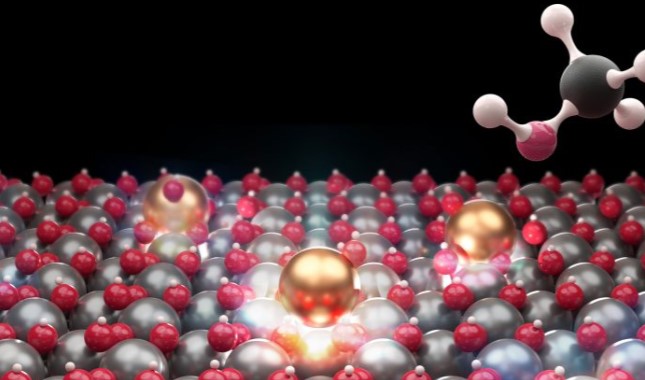
A new catalyst built from isolated indium atoms allows scientists to convert CO2 into methanol more efficiently while revealing the hidden chemistry that drives the reaction.
Methanol is an important building block for many chemical products. Scientists at ETH Zurich have now developed a highly efficient method for producing this compound from carbon dioxide (CO2) and hydrogen by using catalysts made from individual metal atoms.
Every chemical reaction must overcome an energy barrier before it can occur. In simple situations, this barrier can be relatively small. Striking a match, for example, provides enough energy to start a reaction. In many industrial processes, however, the required energy is much higher. Supplying that energy increases operating costs.
To make reactions easier to start, chemists rely on catalysts. These substances speed up chemical reactions without being consumed in the process. Many of the most effective catalysts contain metals, including some that are rare and expensive.
Better, more efficient, and leaving nothing to chance
Chemists have now reported a major advance in catalyst research:
- The team created a catalyst that greatly lowers the energy needed to produce methanol, an alcohol, from the greenhouse gas CO2 and hydrogen.
- Their design uses the metal indium in an extremely efficient way. Each individual indium atom acts as an active site where the chemical reaction occurs.
- The catalyst also provides scientists with a clearer view of the chemical processes happening on its surface. In the past, catalyst development often relied on trial and error. The new system allows researchers to study reaction mechanisms more precisely, which could support a more systematic approach to designing future catalysts.
The Swiss army knife of green chemistry
“Methanol is a universal precursor for the production of a wide range of chemicals and materials, such as plastics – the Swiss army knife of chemistry, so to speak,” says Javier Pérez-Ramírez, Professor of Catalysis Engineering at ETH Zurich. The liquid therefore plays a vital role in the transition to sustainable and fossil-free production of chemical products and fuels.
Because methanol can be transformed into fuels, plastics, and many other products, it plays an important role in efforts to shift toward more sustainable and fossil-free manufacturing.
f the hydrogen required for the reaction and the energy that drives the catalytic process are produced using renewable sources, methanol itself could be made in a climate-neutral way. In that case, CO2 from the atmosphere would become a raw material rather than simply a waste product released into the air.
Maximum use of the metals
“Our new catalyst has a single atom architecture, in which isolated active metal atoms are anchored on the surface of a specially developed support material,” Pérez-Ramírez explains. In conventional catalysts, on the other hand, metals are usually present as aggregates, usually small particles. Although these particles are tiny, they often contain between a hundred and several thousand metal atoms.
In conventional catalysts, metals are typically present as clusters or nanoparticles. Even though these particles are extremely small, each one can contain anywhere from a hundred to several thousand metal atoms. Only the atoms on the surface actively participate in the reaction.
Single-atom catalysts aim to eliminate that inefficiency. By dispersing metals as individual atoms, researchers can maximize the use of scarce and costly elements. In some cases, this strategy could even make precious metals economically practical for large-scale industrial use.
Working at the level of single atoms can also change how a metal behaves chemically. “Indium has already been used in this catalyst for over a decade,” says Pérez-Ramírez. “In our study, we show that isolated indium atoms on hafnium oxide allow more efficient CO2-based methanol synthesis than indium in the form of nanoparticles containing large numbers of atoms.”
Single atoms in the right place
Securing individual indium atoms onto a hafnium oxide surface required careful engineering. The interdisciplinary ETH team developed several synthetic routes in collaboration with researchers from other institutions.
A critical factor was the design of the support material. Its structure provides a setting that is both stable and chemically active, allowing the isolated atoms to remain in place while still participating in the reaction.
In one manufacturing approach tested by the researchers, the starting materials are burned in a flame at temperatures between 2,000 and 3,000°C (about 3,600 to 5,400°F) and then cooled very rapidly. Under these extreme conditions, indium atoms tend to stay on the surface, where they become firmly embedded.
By incorporating the metal atoms into a heat-resistant hafnium oxide support, the scientists demonstrated that single-atom catalysts can remain stable even under demanding conditions. This is crucial because industrial methanol production from CO2 and hydrogen requires temperatures of up to 300°C (about 572°F) and pressures up to 50 times normal atmospheric pressure.
Interaction between the catalyst metal and the matrix
Another advantage of single-atom catalysts is that they are easier to analyze.
With traditional nanoparticle catalysts, most measurement signals come from atoms inside the particles, even though only surface atoms drive the reaction. This makes it difficult to determine exactly what is happening during the process.
In contrast, when metals are dispersed as isolated atoms, there are far fewer extraneous signals. Researchers can more clearly observe the reaction mechanisms taking place.
Pérez-Ramírez has been investigating improved catalysts for methanol production from CO2 at ETH since 2010. He also collaborates closely with industry and holds several patents in this field.
According to Pérez-Ramírez, the strong network of catalysis research in Switzerland played a central role in this achievement. “The development of the methanol catalyst and the detailed analysis of the mechanism would not have been possible without this interdisciplinary expertise.”


comments


Other categories
Recent Comments