


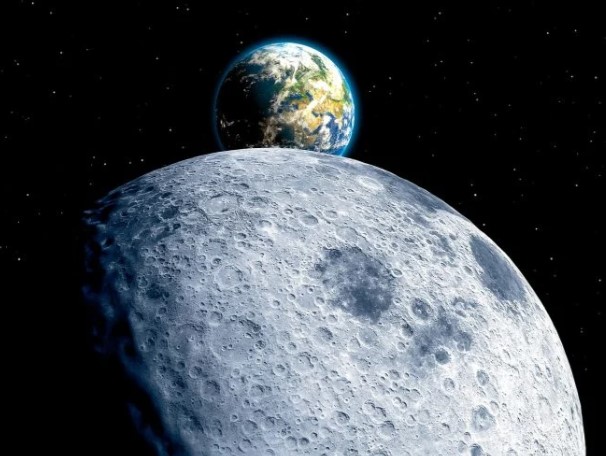
For many years, scientists have proposed that water-rich meteorites striking Earth late in its history may have delivered a significant share of the planet’s oceans. However, new research indicates that evidence preserved on the Moon places strict limits on that idea.
According to the study, even under generous assumptions, meteorites impacting the Earth–Moon system since roughly 4 billion years ago could account for only a minor fraction of Earth’s water.
The research, published in the Proceedings of the National Academy of Sciences, was led by Tony Gargano, Ph.D., of the Lunar and Planetary Institute and the University of New Mexico. The team examined a wide collection of Apollo lunar regolith samples and measured their triple oxygen isotope signatures with high precision.
Earth itself holds little physical evidence of the intense bombardment that occurred early in its history. Plate tectonics and ongoing recycling of the crust have erased much of that record. The Moon, in contrast, preserves a detailed history in its regolith, a surface layer of loose debris that has been created and repeatedly reworked by impacts over billions of years.
Since the Apollo missions returned samples, scientists have tried to decode this record by examining elements that are common in impacting bodies. These include siderophile elements, often described as metal-loving elements, which are abundant in meteorites but relatively scarce in the Moon’s silicate crust. Interpreting the regolith is difficult, however, because impacts repeatedly melt, vaporize, and remix materials. Geological processes after impacts can also separate metal from silicate, making it harder to determine exactly how much meteorite material was added and what kinds of objects delivered it.
Lunar Regolith: A Long-Term Archive of Impacts
“The lunar regolith, which is a collection of loose ‘soil’ and broken rock at the surface, acts like a long-term mixing layer,” said Gargano. “It captures impact debris
stirs it in, and preserves those additions for immense spans of time. That is why it is such a powerful archive. It lets us study a time-averaged record of what was hitting the Earth–Moon system.”
Instead of focusing on metal-loving elements, the researchers used a different method. They analyzed oxygen, the most abundant element in rocks, and examined its triple-isotope signature. This isotopic “fingerprint” helps distinguish two signals that often overlap in lunar regolith: (1) the addition of meteorite material and (2) isotopic changes caused by vaporization during impacts.
By studying subtle shifts in the oxygen isotope composition of lunar soil, the researchers determined that at least ~1% of the regolith by mass consists of material originating from impactors. The data suggest these materials most likely came from carbon-rich meteorites that were partly vaporized when they struck the Moon.
“Triple oxygen isotopes give us a more direct and quantitative way to approach the problem. Oxygen is the dominant element in most rocks, and the triple-isotope framework helps us distinguish true mixing between different reservoirs from the isotopic effects of impact-driven vaporization,” said Gargano. “In practice, that lets us isolate an impactor fingerprint from a regolith that has a complicated history, with fewer assumptions and a clearer chain from measurement to interpretation.”
Oxygen Isotopes Reveal Meteorite Contributions
Using these measurements, the researchers estimated how much water those impactors could have delivered to both the Moon and Earth. The results were expressed in Earth-ocean equivalents to provide a familiar comparison. For the Moon, the total water delivered since ~4 billion years ago is extremely small when measured against the size of Earth’s oceans. Yet that does not mean the contribution is unimportant for the Moon.
Water on the Moon exists mainly in small reservoirs trapped in permanently shadowed regions. Even limited amounts could be valuable for future exploration. Water resources could support life support systems, provide radiation shielding, and serve as a source of fuel for sustained human activity on the lunar surface. As a result, the steady but small addition of water from impactors could still play a meaningful role in the Moon’s overall water inventory.
The team then applied the same calculations to Earth. Scientists generally estimate that Earth receives much more impactor material than the Moon, often by a factor of about 20×. Even using that scaling and assuming the extreme case of a thick megaregolith layer, the total water delivered through these late impacts would amount to only a few percent of one Earth ocean at most. Considering that Earth is believed to contain several ocean masses of water overall, this amount is far too small for late-arriving meteorites to explain the majority of Earth’s oceans.
Implications for the Origin of Earth’s Oceans
“The lunar regolith is one of the rare places we can still interpret a time-integrated record of what was hitting Earth’s neighborhood for billions of years,” said Gargano. “The oxygen-isotope fingerprint lets us pull an impactor signal out of a mixture that’s been melted, vaporized, and reworked countless times. The main takeaway from our study is that Earth’s water budget is hard, if not impossible, to explain if we only consider a single, late delivery pathway from water-rich impactors from the outer solar system. Even though some meteorite types carry a lot of water, their broader chemical and isotopic fingerprints are quite exotic relative to Earth. Habitability models have to satisfy such empirical constraints, and our study adds a constraint that future theories will need to reproduce.”
“Our results don’t say meteorites delivered no water,” added Simon. “They say the Moon’s long-term record makes it very hard for late meteorite delivery to be the dominant source of Earth’s oceans.”
Gargano also emphasized that the research builds on decades of work that began with the Apollo program. “I’m part of the next generation of Apollo scientists – people who didn’t fly the missions but who were trained on the samples and the questions Apollo made possible,” Gargano said. “The value of the Moon is that it gives us ground truth: real material we can measure in the lab and use to anchor what we infer from meteorites and telescopes.
“Apollo samples are the reference point for comparing the Moon to the broader Solar System,” Gargano added. “When we put lunar soils and meteorites on the same oxygen-isotope scale, we’re testing ideas about what kinds of bodies were supplying water to the inner Solar System. That’s ultimately a question about why Earth became habitable and how the ingredients for life were assembled here in the first place.”
Apollo Samples and the Record of Solar System Impacts
Apollo samples remain valuable because the Moon preserves a long history of impacts that Earth no longer retains. The lunar surface records the environment of the inner solar system across billions of years, providing clues about the conditions under which Earth became habitable. Rocks collected decades ago from another world continue to reshape scientific thinking about how Earth obtained its water and how the ingredients for life were assembled.
What modern techniques add to this amazing legacy of scientific exploration is precision and interpretive power. We can now resolve subtle isotopic signals that allow quantitative tests of formation and habitability models,” said Gargano. “That is why Apollo science keeps evolving. The samples are the same, but our ability to interrogate them and the questions we can ask of them are fundamentally better.”
Training the Next Generation of Planetary Scientists
Alongside the research itself, Gargano highlighted the importance of education and outreach. Efforts to train students help connect distant scientific discoveries with real-world experience and opportunity.
“At UNM, I have been training Albuquerque high schoolers in planetary science and geochemistry, including senior Brooklyn Bird and junior Violet Delu from the Bosque School,” said Gargano. “These students are getting hands-on training in geochemistry using UNM’s unique collection of astromaterials, and they are learning the physical craft of laboratory science: how to prepare and handle samples, how to make high-quality measurements, and how to think clearly about uncertainty and reproducibility.
“But the deeper lesson is the transformation that happens when a student realizes they can hold a piece of another world, make a measurement, and pull meaning out of it. They learn how a chemical signal becomes a geologic story and how that story scales up into an explanation for how a planetary body evolved to become the way it is. Experiences like that change what students think is possible for themselves. They build confidence, technical ability, and a sense of belonging in a field that can otherwise feel out of reach.”


comments


Other categories
Recent Comments