


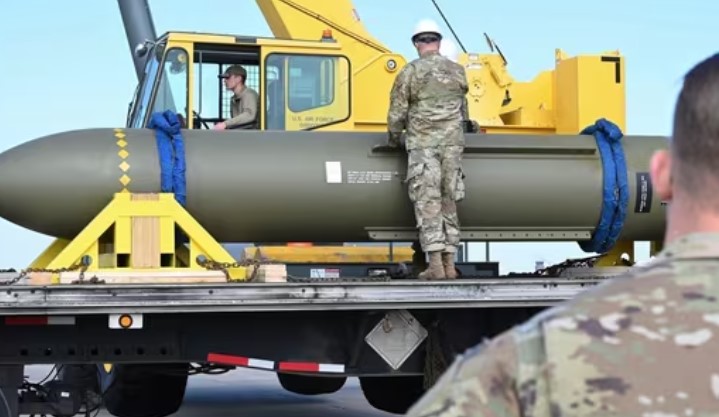
Isfahan is a critical military hub and is closely linked to Iran's nuclear infrastructure. The attack comes hours after Trump hinted at ending the war with Iran
The United States struck a key ammunition facility in Iran's Isfahan using 2,000-pound bunker-buster bombs, just hours after President Donald Trump hinted at ending the offensive.
According to a US official who spoke to Wall Street Journal, a large number of penetrator munitions were used in the operation, suggesting the target included fortified or underground structures. Isfahan is a critical military hub and is closely linked to Iran's nuclear infrastructure.
Trump also shared footage of the strike on Truth Social, posting a video that shows multiple explosions tearing through the night sky. The clip, which was not accompanied by any explanation, was later identified by officials as showing the Isfahan attack.
Visuals from the video capture successive detonations followed by intense fires and plumes of smoke, pointing to secondary blasts likely caused by munitions stored at the site. The footage has not been independently verified.Isfahan's strategic importance has grown in recent weeks amid reports that Iran may have shifted a portion of its highly enriched uranium, estimated at about 540 kg, to underground facilities in the city.
What are Bunker Buster bombs?
Bunker-buster bombs are specialised weapons built to penetrate hardened targets before exploding. They are typically used against underground military installations, reinforced bunkers and nuclear sites.
Among the most powerful in this category is the Massive Ordnance Penetrator (MOP), a 30,000-pound bomb developed by Boeing. Designed with a reinforced steel casing and precision GPS guidance, the weapon can drill through layers of concrete and rock before detonating, delivering a high-impact blast deep below the surface.
The MOP is so large that it can only be carried by the B-2 Spirit, an aircraft built to evade advanced air defence systems and strike heavily protected targets. While the Isfahan operation reportedly used smaller bunker-buster variants, the objective remains similar - neutralising deeply buried infrastructure.
Middle East tensions flare
The strike in Isfahan came hours after Iran targeted a Kuwaiti oil tanker, Al-Salmi, near the coast of Dubai, signalling a potential expansion of the conflict into vital energy corridors. No casualties were reported, though authorities warned of a possible oil spill following the incident.
Trump willing to end the war?
The US President has told his aides that he's willing to end the military operation against Iran even if the Strait of Hormuz remains largely closed, leaving the campaign to reopen it for a later date, the Wall Street Journal reported, citing administration officials.
In recent days, Trump and his aides assessed that a mission to pry open the chokepoint would push the conflict beyond his timeline of four to six weeks, the Daily said in a report.
According to the report, Trump decided that the US should achieve its main goals of hobbling Iran's navy and its missile stocks and wind down current hostilities while pressuring Tehran diplomatically to resume the free flow of trade.
If that fails, Washington would press allies in Europe and the Gulf to take the lead on reopening the strait, the WSJ said, quoting officials.


comments


Other categories
Recent Comments