


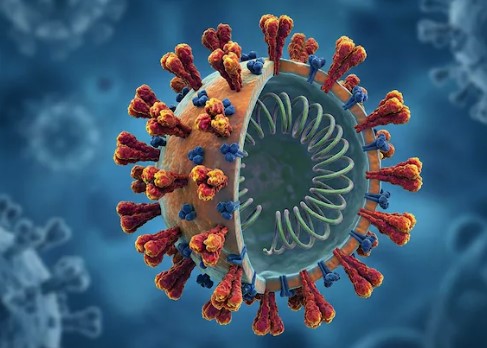
BA.3.2 has been designated a Variant Under Monitoring by the World Health Organisation (WHO), meaning it is under close observation.
A Covid-19 subvariant known as BA.3.2, nicknamed Cicada, is spreading rapidly across the United States. The BA.3.2 sub-variant, which belongs to the Omicron family, was first detected in South Africa in late 2024. The variant has been detected in at least 23 countries worldwide. While cases began increasing in September 2025, it hasn't yet become the dominant strain worldwide. According to the U.S. Centres for Disease Control and Prevention (CDC), BA.3.2 mutations in the spike protein have the potential to evade protection from a previous infection or vaccination. In the US, it was first detected in nasal swabs from four travellers. Since then, it has been detected in patients and the wastewater systems of 29 states.
What is the Cicada variant?
BA.3.2 has been designated a Variant Under Monitoring by the World Health Organisation (WHO), meaning it is under close observation to see if it becomes more dangerous. But it is not currently considered a major threat like other previous variants.
Cicada is a heavily mutated Omicron subvariant that carries 70 to 75 new mutations in the spike protein, which is significantly more than the 30 mutations found in the original Omicron strain. However, there is currently no evidence that it causes more severe disease.
It is called Cicada because it appeared to have evolved quietly for years before suddenly re-emerging. It descended from the older BA.3 lineage that was last common in early 2022.
What are the symptoms of the Cicada Covid-19 variant?
Symptoms of the Cicada variant are largely similar to previous Omicron strains, primarily affecting the upper respiratory tract.
- Common symptoms include sore throat, fever, chills, cough, fatigue, headache, and nasal congestion.
- Less common symptoms include nausea, vomiting, diarrhoea, and loss of taste or smell.
How is it different from other Covid-19 variants?
Researchers indicate that Cicada carries 70 to 75 new mutations in the spike protein, the component that the human immune system identifies and targets. This number is higher than that observed in the more prevalent variants that emerged in 2023. However, Cicada still belongs to the Omicron family of viruses, which first emerged in 2021 (also in South Africa), suggesting it may retain some genetic similarities to more recent variants.
Is vaccination helpful?
While the variant may be less affected by current vaccines, which were designed for the JN.1 and LP.8.1 lineages, researchers emphasise that vaccination still provides strong protection against severe disease and death.
Is India at risk?
According to WHO, the BA.3.2 variant has not shown significant growth compared to faster-growing variants like NB.1.8.1 and XFG. It is still rare worldwide. Currently, there are no reports of increased disease severity linked to this variant.
In India, there is no need to panic. So far, there has been no significant increase in infections linked to BA.3.2 reported. Additionally, most cases reported globally have been mild or recovered with standard care.
While the virus is being monitored closely by experts, it is not a cause for immediate concern.


comments


Other categories
Recent Comments