


Lebanon was drawn into the Middle East war on March 2 when Tehran-backed militant group Hezbollah launched attacks on Israel to avenge the killing of Iran's leader Ayatollah Ali Khamenei.
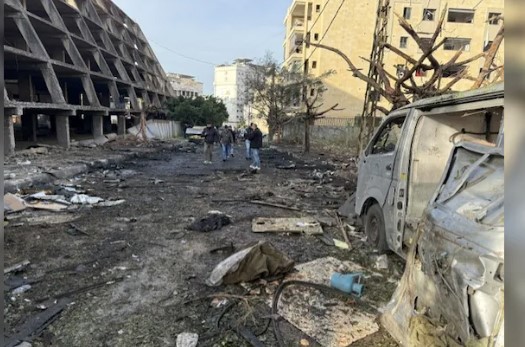
At least 10 people were killed and 20 others injured after multiple missiles hit the Jnah neighbourhood of Lebanon's capital Beirut during overnight bombing.
Lebanon was drawn into the Middle East war on March 2 when Tehran-backed militant group Hezbollah launched attacks on Israel to avenge the killing of Iran's leader Ayatollah Ali Khamenei. Israel has since responded with widespread air strikes across Lebanon and launched a ground offensive.
The overnight attacks appeared to have targeted multiple parked cars in Jnah. Several nearby buildings were also damaged in the heavy bombing. NDTV visited the attack site and found massive destruction caused by the strikes. At least three large missile craters were seen, while wrecked vehicles and debris were scattered across the area.
The Israel Defense Forces (IDF) said they carried out two overnight raids in Beirut.
"During the night, the IDF launched two raids in Beirut, one targeting a senior Hezbollah terrorist leader and the other another senior terrorist leader," an IDF spokesperson said.
The identity of those killed in the attacks was not immediately known. It also remains unclear why a car parking area was targeted during the strikes that shook Beirut.
Some Israel-linked outlets claimed that a Hezbollah convoy was hit in the attack, killing at least 11 people in multiple missile strikes.
A day earlier, the IDF carried out a major strike on a building near Beirut airport. The attack was caught on camera, showing the multi-storey building being destroyed.
Over the last 24 hours, Israel has intensified its attacks on Lebanon following the killing of four Israeli soldiers in a fierce gunbattle with Hezbollah.
Three United Nations peacekeeping personnel from Indonesia were also killed during attacks in Lebanon. While Israel has denied responsibility for the deaths of UN peacekeepers, the United Nations Security Council held an emergency meeting over the incidents. UN Secretary-General Antonio Guterres called for accountability and said no one should die while serving the cause of peace.
On Monday, four Israeli soldiers were killed in southern Lebanon as Israel launched a major offensive aimed at capturing and occupying parts of the region. Israel has said it plans to capture and occupy areas south of the Litani River to create a security buffer zone. On Sunday, Israeli Prime Minister Benjamin Netanyahu instructed the army to expand the offensive.
On Sunday, nine health workers
and UN peacekeeping personnel were among those killed in attacks across the country.
As part of the invasion in southern Lebanon, the IDF issued "urgent" evacuation warnings to residents of several villages in the Beqaa Valley. Since the outbreak of the war, around 1,200 people have been killed and more than 12 lakh people displaced in Lebanon.
Hezbollah has said it will continue to fight as long as occupation and aggression persist. The group claimed that its fighters have so far prevented Israel from capturing areas south of the Litani River.
Meanwhile, Lebanese authorities say the conflict has killed more than 1,200 people and displaced over one million so far.
Israel has said it intends to occupy parts of southern Lebanon to establish what officials have described as a buffer zone aimed at pushing Hezbollah away from border areas.
Defence Minister Israel Katz said on Tuesday that "all the houses in the villages adjacent to the border in Lebanon will be demolished."
Katz's Lebanese counterpart Michel Menassa decried plans for "a new occupation", while Canada's Prime Minister Mark Carney denounced Israel's deployment as an "illegal invasion."


comments


Other categories
Recent Comments