


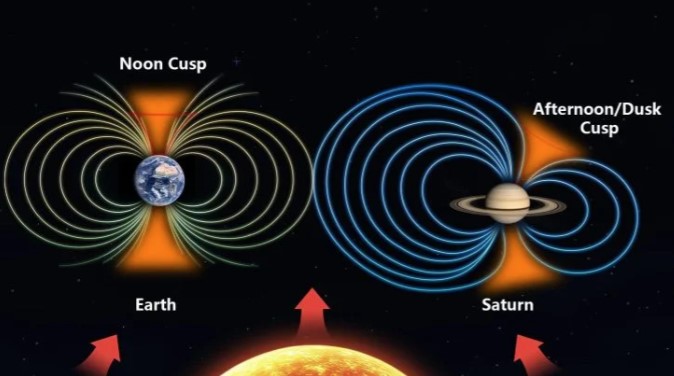
Saturn’s magnetic shield is unexpectedly lopsided, with its entry point for solar particles pushed off-center. Scientists believe its fast spin and material from its moon Enceladus are warping the entire system.
Saturn’s magnetic field does not form a neat, balanced bubble like Earth’s. Instead, it appears uneven and shifted, according to a new study involving researchers from University College London (UCL). Scientists believe this distortion is driven by the planet’s rapid rotation and the large amount of material it drags through space.
Planetary magnetic fields (magnetospheres) act as shields, protecting planets from streams of highly charged particles carried by the solar wind. Saturn’s magnetosphere is enormous, stretching to more than 10 times the planet’s diameter.
Cassini Data Reveals a Shifted Magnetic “Cusp”
The research, published today (April 1) in Nature Communications, analyzed six years of observations from NASA’s Cassini mission. The team focused on pinpointing the location of Saturn’s “cusp” – a key region where magnetic field lines bend back toward the poles and guide charged particles into the atmosphere.
They discovered that this cusp is not centered. Instead, it is consistently pushed to the right when viewed from the Sun. It most often appears between 1 and 3 o’clock (as it might appear on a clockface), rather than at 12 o’clock as seen on Earth.
Fast Rotation and Plasma From Enceladus
Researchers suggest that two major factors are responsible for this shift. Saturn spins extremely quickly, completing a full rotation in just 10.7 hours. At the same time, it is surrounded by a dense “soup” of plasma (ionized gas), much of which originates from gases released by its moons, especially Enceladus.
Together, the fast spin and this heavy plasma environment appear to pull the magnetic field lines sideways. However, scientists note that additional simulations are needed to fully confirm this explanation.
Why Saturn’s Environment Matters
Understanding Saturn’s magnetic environment is especially important because of growing interest in its moon Enceladus. This icy world releases plumes from a subsurface ocean and is considered a strong candidate for hosting life. It is also a key target for a proposed European Space Agency mission planned for the 2040s.
Co-author Professor Andrew Coates (Mullard Space Science Laboratory at UCL) said: “The cusp is the place where the solar wind can slip directly into the magnetosphere. Knowing the location of Saturn’s cusp can help us better understand and map the whole magnetic bubble.
“A better understanding of Saturn’s environment is especially urgent now as plans for our return to Saturn and its moon Enceladus start to be developed. These results feed into the excitement that we are going back there. This time we will look for evidence of habitability and for potential signs of life.
“This study also provides critical evidence for a long-held theory – that the rapid spin of massive planets like Saturn with active moons replaces the solar wind as the dominant force shaping magnetospheres. It shows that Saturn’s magnetosphere, as well as the magnetospheres of other rapidly spinning gas giants, likely differ fundamentally from Earth’s.”
“Enceladus itself is a key driver of this environment, releasing huge amounts of water vapor that gets ionized, loading the magnetosphere with heavy plasma that is then pulled around as the planet spins.”
New Clues About Planetary Magnetic Fields
The international team included scientists from the Chinese Academy of Sciences, the Southern University of Science and Technology, and the University of Hong Kong.
Corresponding author Professor Zhonghua Yao (The University of Hong Kong) said: “The differences between Saturn’s magnetic structure and that of Earth point to a unified fundamental process governing solar wind interaction across different planets. Comprehensive terrestrial observations reveal the working mechanisms of Earth, while comparative studies between planets inform us of the fundamental laws that can be applied to understand other systems, such as exoplanets.”
Lead author Dr. Yan Xu (Southern University of Science and Technology in China) said: “By combining Cassini observations with simulations, we found that Saturn’s rapid rotation and the plasma from its moon Enceladus together shape the asymmetric global distribution of the cusps. We hope this gives some useful reference for future exploration of Jupiter’s and Saturn’s space environments.”
Inside the Cassini Measurements
To identify when Cassini passed through the cusp, researchers examined data from two onboard instruments (the Cassini Magnetometer, or MAG, and Cassini Plasma Spectrometer, CAPS). They identified 67 such encounters between 2004 and 2010, using indicators such as the energy levels of detected electrons.
Using these observations, the team modeled Saturn’s magnetic field. They found that interactions between the magnetosphere and the solar wind at its outer boundary closely resemble processes seen at Jupiter.
A key contribution to the study came from the CAPS electron sensor, which was developed by a team led by Professor Coates at the Mullard Space Science Laboratory at UCL.The research was supported by the UK’s Science & Technology Facilities Council and the National Natural Science Foundation of China, along with other funding organizations.


comments


Other categories
Recent Comments