


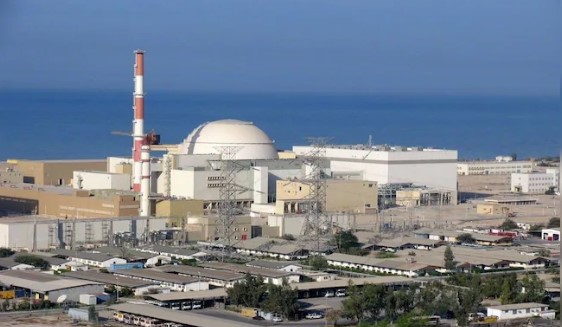
Bushehr, itself a city of around 2,50,000 people, is considerably closer to Kuwait, Bahrain and Qatar than it is to the Iranian capital.
New Delhi:
As a projectile landed barely 350 metres from Iran's Bushehr nuclear power plant on Saturday, the fourth such strike since the war began on February 28, concerns spanned across the Gulf region.
Iranian Foreign Minister Abbas Araghchi warned that continued attacks on the plant on Iran's southern coast could eventually lead to radioactive fallout that would "end life in GCC (Gulf Cooperation Council) capitals, not Tehran".
About Bushehr Nuclear Plant
The project to construct Bushehr nuclear power plant, Iran's only operational civilian nuclear facility, began in 1975 during the Shah's reign, and was initially awarded to Germany's Siemens. But work on it was interrupted by the 1979 Islamic Revolution and the Iran-Iraq War (1980-1988).
Iran sought to revive the project in the late 1980s, but Germany's government persuaded Siemens to withdraw over concerns about nuclear proliferation. The plant was finally built by Russia, which took over the contract in 1996 and officially handed over in September 2013. The deadline to commission the reactor in 1999 was delayed by 11 years owing to financial disputes, geopolitical pressure, among other factors.
Follow US-Iran War Live Updates
The facility is located in the south of the country and equipped with a 1,000-megawatt pressurized water reactor. Per CNN, it provides around 1-2 per cent of Iran's total electricity.
Iran has been trying to expand Bushehr to multiple reactors. In 2019, it began a project that ultimately plans to add two additional reactors to the site, each adding another 1,000 megawatts apiece. A satellite image from December from Planet Labs PBC showed the construction still ongoing at the site, with cranes over both sites.
The reactor currently running at Bushehr uses uranium from Russia enriched to 4.5 per cent, a low level needed for power generation in such plants. Per the House of Saud, Bushehr facility contains approximately 282 tons of nuclear material. This comprises 72 tons of active fuel in the reactor core and approximately 210 tons of spent fuel in the plant's elevated storage pool. The caesium-137 inventory in the spent fuel is approximately 2,600 petabecquerels, more than ten times the amount released during the Chernobyl disaster.
Why Do The Strikes Worry Other Countries?
Bushehr, itself a city of around 2,50,000 people, is considerably closer to Kuwait, Bahrain and Qatar than it is to the Iranian capital. From Bushehr, Kuwait City is approximately 270 kilometres across the water, Bahrain's capital Manama is roughly 350 kilometres away, Saudi Arabia's Dammam, Dhahran and Al Khobar are 400 kilometres away, Doha lies approximately 450 kilometres to the south, while Riyadh is 750 kilometres distant.
The three desert states, facing Iran on the opposite side of the Persian Gulf, have minimal natural water reserves and are home to more than 18 million people whose only supply of drinking water is desalinated water drawn from the Gulf.
Add to this, concerns flagged by the IAEA and experts about the plant's easy-to-hit above-ground reactor design. Should a strike hit the reactor or fuel storage pools, radiological particles, specifically the hazardous isotope Caesium-137, will be released into the atmosphere. The shield created north of the Bushehr by the Zagros mountains combined with northwesterly winds would send the fallout drifting towards Kuwait, Bahrain, Qatar and the UAE. Food, soil and water in the impact zone would be contaminated, possibly for decades. The immediate effect would be burns and deaths, the longer term would see increased cancer risks, per an Al Jazeera report. Needless to say, desalination plants that lie in the way will also be impacted.
Neighbouring Arab Gulf states have frequently expressed concerns about the plant's reliability and raised the risk of radioactive leaks in the event of a major earthquake. Last year, Qatar's Prime Minister Sheikh Mohammed bin Abdulrahman Al Thani warned that an attack on Iran's nuclear sites would leave the Gulf with "no water, no fish, nothing ... no life".
Alan Eyre of the Middle East Institute told Al Jazeera that concentration of radioactive material at Bushehr might not be enough to cause a Chernobyl-level disaster, but radioactivity in the water could halt desalination altogether.
Though modern nuclear reactors are designed to shut off within minutes of impact to stop the nuclear reaction, the risks remain. A failure in the cooling infrastructure could lead to a reactor meltdown, leading to the spread of radioactive material.
Other Nuclear Sites In Iran
Natanz Fuel Enrichment Plant: The largest, mostly underground, facility for uranium enrichment. It has been targeted multiple times.
Fordow Fuel Enrichment Plant: A heavily fortified, underground enrichment site built into a mountain.
Isfahan Conversion Center: Contains uranium conversion facilities and a fuel fabrication plant.
Arak Heavy Water Nuclear Power Plant: A heavy water production plant and a 40-megawatt heavy water reactor.
Previous Nuclear Disasters
In the April 1986, the Chernobyl nuclear reactor in Ukraine exploded during tests. A massive explosion blew off the facility's roof and resulted in a fire that burned for days. 30 people died immediately, while thousands developed thyroid cancer. Over 3,00,000 people were evacuated.
In 2011, an earthquake caused Japan's Fukushima nuclear reactors to melt. Around 1,60,000 people were evacuated.


comments


Other categories
Recent Comments