


An unprecedented neutrino detection in the Mediterranean has pushed the boundaries of high-energy astrophysics, raising new questions about the most extreme processes in the universe.
Three years ago, scientists detected an “ultra-energetic” cosmic neutrino in the Mediterranean Sea, the most energetic ever recorded. The discovery drew global attention from researchers, the media, and the public. One reason for the intense interest is that the particle’s origin remains unknown. Its energy was more than ten times higher than that of any previously observed neutrino.
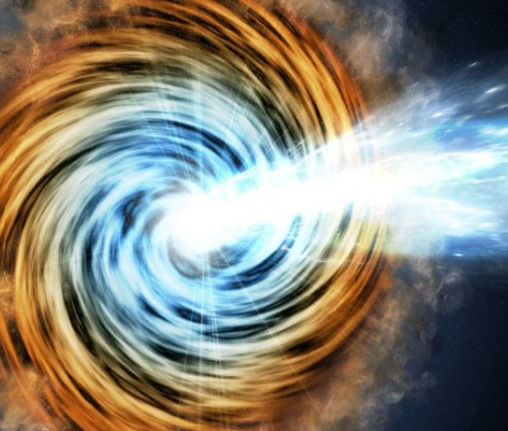
A study published in the Journal of Cosmology and Astroparticle Physics (JCAP) by the KM3NeT collaboration points to a possible explanation. The team operates the KM3NeT/ARCA detector off the coast of Sicily and suggests the particle may have come from a population of blazars. These are active galactic nuclei powered by supermassive black holes that shoot jets of plasma toward Earth.
In Search of the “Culprit”
KM3NeT/ARCA is a deep-sea neutrino detector near Sicily, and it is still being built. Even so, on February 13, 2023, it captured an extraordinary signal. The detected neutrino had an energy of about 220 PeV (about 35 joules), far beyond any previously measured high-energy neutrino. The finding surprised scientists and raised a key question: what kind of source could produce such an extreme particle?
To investigate, researchers used an approach similar to forensic analysis. They started with possible explanations, ran simulations of those scenarios, and compared the results with the actual data.
One leading idea is that the neutrino came from a certain type of blazar. “There are several possible explanations for the origin of this particle,” explains Meriem Bendahman of INFN Naples and the KM3NeT collaboration. “For example, it has been proposed that such neutrinos are generated when ultra-high-energy cosmic rays interact with the cosmic microwave background radiation, the residual light from the early Universe. But there is also the possibility that the neutrino originates from a diffuse flux produced by a population of extreme accelerators, such as blazars.”
A Diffuse Source Rather Than a Single Event
Bendahman and her colleagues found clues suggesting the neutrino did not come from a single dramatic event such as an explosion or flare. In such cases, scientists usually look for an electromagnetic “counterpart,” meaning a signal in radio, optical, X-ray, or gamma-ray wavelengths from the same region of the sky at the same time.
No such signal was detected for this event. “This does not completely rule out the possibility of a point-like source,” Bendahman says, “but it leads us to consider that our neutrino may come from a diffuse background — that is, from a flux of neutrinos including contributions from many sources.”
To test this idea, the team simulated a population of blazars using open-source software called AM3. They based many inputs on existing observations, such as magnetic field strength and the size of the emission region.
They focused on two main variables: baryonic loading, which describes how much energy is carried by protons compared to electrons, and the proton spectral index, which determines how proton energies are distributed. These factors influence how many neutrinos are produced and how energetic they can become.
For each scenario, the researchers calculated both the expected neutrino flux and the associated gamma-ray emission, then compared those results with real observations.
Cross-Checking With IceCube and Fermi
A major strength of the study is its use of multiple datasets. Along with KM3NeT/ARCA measurements, the team analyzed data from the IceCube Neutrino Observatory and the Fermi Gamma-ray Space Telescope. They considered both detections and the lack of detections.
The absence of similar ultra-high-energy neutrinos in existing datasets, including IceCube, indicates that such events are extremely rare. Any explanation must account for this, and the blazar scenario does.
The researchers also checked that the predicted gamma-ray output from blazars does not exceed the extragalactic gamma-ray background measured by Fermi. Their model remains consistent with these limits.
As Bendahman explains, “We modeled a realistic population of blazars with physically motivated parameters, and we found that this population of blazars could explain the origin of this ultra-high-energy event, while also being consistent with the constraints that we have regarding the gamma-ray and neutrino observations.”
KM3NeT and the Future of Neutrino Astronomy
The blazar explanation is promising, but more data is needed to confirm it. “We need more observational data,” says Bendahman. “KM3NeT is still under construction, and we detected this ultra-high-energy neutrino with only a partial configuration. With the full detector and more data, we will be able to perform more powerful statistical analyses and open a new window on the ultra-high-energy neutrino universe.”
At the time of the detection, only 21 detection lines were active, about 10% of the detector’s planned size.
If this interpretation is confirmed, it would reshape understanding of how blazars accelerate particles. “We have never observed such a high-energy neutrino before, and if it turns out to come from cosmic accelerators like blazars,” Bendahman concludes, “it would give us new insight into how these objects can emit particles at energies beyond what we previously expected.”


comments


Other categories
Recent Comments