


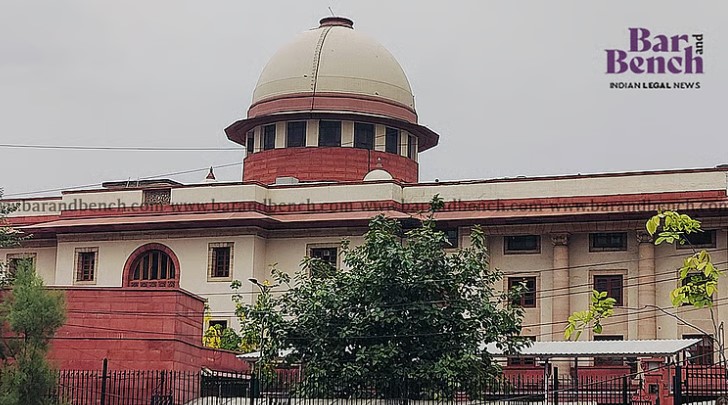
The Court closed a 20-year-old forgery case against the purchaser of a property, finding no evidence that he participated in preparing or using an allegedly forged Will.
The Supreme Court recently held that a person who purchases property cannot be prosecuted for cheating or forgery merely because the property is later found to be linked to a disputed or allegedly forged Will [S Anand vs. State of Tamil Nadu & Anr.].
A Bench of Justices Vikram Nath and Sandeep Mehta quashed criminal proceedings against a buyer who was named an accused in a long-running property dispute. The Court found that there was no material showing his involvement in the alleged fabrication of a Will tied to the property.
The case arose from allegations that a Will dated September 12, 1988, had been forged to transfer land belonging to a deceased owner. Based on the disputed Will, the property was later sold to multiple purchasers through registered sale deeds executed in 1998.
One of the purchasers was arrayed as an accused and charged with offences including cheating, forgery and criminal conspiracy. He approached the Madras High Court seeking the quashing of the case, contending that he had purchased the property for valid consideration after verifying the seller’s title and had no role in creating the allegedly forged Will.
The High Court refused to quash the proceedings, stating that the issues raised involved disputed questions of fact requiring a trial.
Setting aside this decision, the Supreme Court noted that there was not even an iota of evidence to show that the appellant (buyer) had participated in preparing the alleged forged Will or had knowledge that it was fabricated.
The Court further observed that even if the Will were ultimately found to be forged, the purchasers themselves would be affected, as their ownership rights would become uncertain.
Relying on its earlier ruling in Mohammed Ibrahim v. State of Bihar, the Court reiterated that criminal liability for cheating requires proof that the accused deceived the complainant or knowingly participated in the fraudulent act.
In the absence of such material, the Court held that allowing the criminal case to proceed against the purchaser would amount to an abuse of the process of law.
Accordingly, the Court set aside the High Court’s order and quashed the criminal proceedings against the appellant.
The petitioner was represented by Senior Advocate Arvind Varma along with advocates Devesh Tripathi, Mohd Faraz Anees, Kartik Vashisht, Kaustubh Chandra Seth, Theepa Murugesan, Sanya Bhatia, Mukeshwar Nath Dubey, Epsita Agastya, Ajay Kumar, Mahima Anand, Divesh, Abhishek Yadav, Anand, Abhishek Dwivedi and Yash Singh.
The respondents were represented by Senior Additional Advocate General V Krishnamurthy and Senior Advocate A Sirajudeen, along with advocates Sabarish Subramanian, Vishnu Unnikrishnan, Azka Sheikh Kalia, Jahnavi Taneja, Veshal Tyagi, A. Lakshminarayanan, S. C. V. Vimal Pani, U. Kathiravan and Shruti Bisht.


comments


Other categories
Recent Comments