


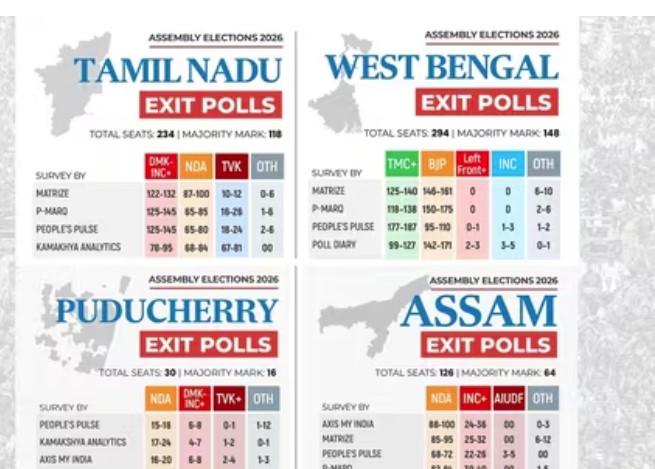
Several exit polls have predicted that the BJP could breach the Mamata Banerjee bastion in West Bengal after 15 years.
The Bharatiya Janata Party (BJP) is headed for a historic victory in West Bengal and a third consecutive term in Assam, the Congress-led United Democratic Front is set to win power in Kerala, and the Dravida Munnetra Kazhagam (DMK) might beat anti-incumbency and retain Tamil Nadu, a clutch of exit polls predicted on Wednesday.
What the exit polls 2026 say
In West Bengal, the largest and most important of the five regions that went to the polls in this cycle, a majority of exit polls forecast that the BJP will achieve a slender majority in the 294-member assembly, beating the Trinamool Congress (TMC). But two major agencies did not put out their predictions for the eastern state where turnouts broke previous records, fuelled by large-scale deletions under the special intensive revision (SIR).
In Tamil Nadu, all but one exit poll predicted that the DMK-led alliance might achieve a majority in the 234-member assembly. AxisMyIndia predicted that actor-turned-politician Vijay could pip both Dravidian majors and end up as the single-largest party – even get a majority – in what could be Tamil Nadu’s first genuinely three-cornered contest in a generation, with the complete collapse of the All India Anna Dravida Munnetra Kazhagam (AIADMK).
In Puducherry, all exit polls predicted that the National Democratic Alliance was set for victory.
The votes will be counted on Monday.
Are exit polls accurate?
To be sure, exit polls are not always accurate and have often got the verdict wrong in earlier elections, especially when diverse populations, castes and communities are at play. In 2021, most exit polls put out wrong predictions for West Bengal, where the TMC won a landslide victory. Similar missteps marked the forecast for the 2024 general elections.
The exit polls came after a weeks-long bruising campaign across the five regions where questions of development, identity, deletions under SIR, and local anti-incumbency dominated.
Three of the states that went to the polls – Bengal, Tamil Nadu and Kerala – have never seen a BJP government and represent the final frontier for the party. The National Democratic Alliance (NDA) is in power in Assam, where it hopes to come back to power for a third consecutive time, and Puducherry, where it is attempting a second straight shot at forming the government.
The elections are also a test of survival for strong regional leaders Mamata Banerjee who is seeking a fourth straight term, MK Stalin who is seeking a second consecutive term, and Pinarayi Vijayan who is seeking a third back-to-back term.
In Kerala, the polls were unanimous in terms of the larger direction of the outcome. They forecast that the UDF – comprising the Congress, Indian Union Muslim League, Kerala Congress (Joseph), Kerala Congress (Jacob), Revolutionary Socialist Party and smaller outfits – will return to power with a simple majority after 10 years in the wilderness. No poll predicted that chief minister Pinarayi Vijayan – who pulled off improbable back-to-back victories in 2016 and 2021 in a state where the two major outfits usually alternate power – will return for a third consecutive term. Some polls predicted that the BJP, still a marginal force in the coastal state, will expand its presence but struggle to convert it into seats.
The polls were unanimous in Assam as well. Every exit poll predicted that chief minister Himanta Biswa Sarma would return with a thumping majority – almost touching two-thirds in the 126-member assembly – in the northeastern state for a second consecutive term, defeating the Congress which was seen as a distant second. The campaign in the state, where migration has been an emotive issue for half a century, was polarised with Sarma pushing to marginalise Bengali-speaking Muslims, pejoratively called Miyas.
In Tamil Nadu, all but one exit poll suggested that Stalin would beat anti-incumbency to register a narrow but important victory in a state where the DMK has historically struggled to hold on to power for a second straight term. Almost every poll suggested that the AIADMK-led NDA in the state will largely repeat its 2021 showing, when it got around 75 seats, and that the new entrant, Vijay’s Tamilaga Vettri Kazhagam, will garner votes but not threaten the two Dravidian majors.
But AxisMyIndia flipped this script, predicting that the TVK might emerge as the single-largest party in the state, even winning a majority on its own. It predicted that the DMK will be right behind the TVK with a complete collapse of the NDA . If these numbers hold, it will be a political upheaval and mark the best showing by an electoral debutant in the state since Tamil screen talisman MG Ramachandran in 1977.
A political earthquake was also predicted in West Bengal by some exit polls that forecast that the BJP – which won 77 seats in 2021 — will cross the majority mark of 148 on its own and comfortably defeat the TMC. One exit poll, by Peoples Pulse, predicted the opposite and said the TMC might get close to a two-thirds majority on its own.
In a state ruled by the Left Front for 34 years and then by Banerjee for another 15, the BJP has tried over the last decade to establish a bastion but has repeatedly failed. If it succeeds in 2026, it will be a historic victory in a state that holds enormous political and social significance for the party as the founder of the Jana Sangh, Syama Prasad Mookerjee, hailed from the state.
The eastern state saw largely violence-free polls manned by a record number of paramilitary personnel – 2,550 companies, almost three times as many in 2016 and 2021 – in a region notorious for political violence. The elections were marked by a combative Election Commission of India that transferred more officials in Bengal than in any other poll-bound region 30 times over, federal agency raids on a number of TMC leaders, and the disenfranchisement of 2.7 million voters who were flagged under a controversial logical discrepancy category under SIR.
The ramifications of these elections will resonate far beyond Kolkata or Chennai, Guwahati or Thiruvananthapuram. For the NDA, it is an opportunity to win territories that have traditionally not warmed up to its ideological or electoral appeal. It will set the mood for a clutch of key assembly polls next spring and can steady the hand of Prime Minister Narendra Modi amid international turbulence.For the Opposition, the elections offer a chance to stem the tide of losses that followed its performance in the 2024 general elections and win major states with enormous political heft.


comments


Other categories
Recent Comments