

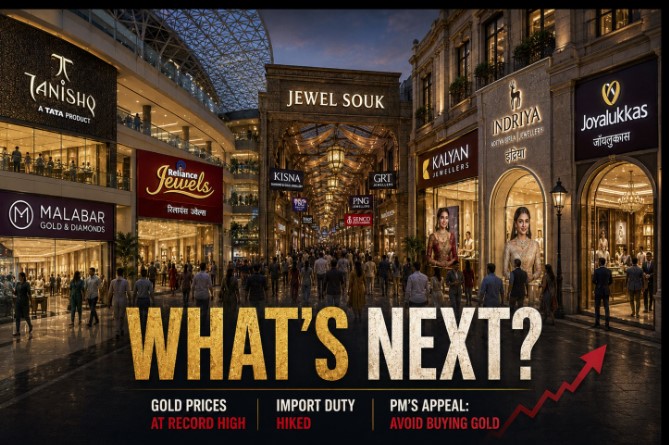
Gold Prices at Historic Highs, Import Duty Hikes and PM’s Appeal Against Gold Buying Raise New Questions for India’s Aggressively Expanding Jewellery Majors
India’s jewellery retail industry is entering one of its most important transition phases in decades.
After an exceptionally strong FY 2025–26 marked by record revenues, aggressive store launches, premium flagship investments and rapid organised retail expansion, the sector now faces a dramatically altered operating environment shaped by historic gold prices, import duty hikes, rising rental costs and changing consumer behaviour.
The Indian jewellery retail market — already a major pillar of the country’s broader gems and jewellery ecosystem — is now estimated to have crossed nearly ₹7.9-₹8.3 lakh crore ($95–100 billion) in FY 2025–26, significantly ahead of earlier estimates. Industry projections had earlier estimated that the market could expand to nearly ₹12.5 lakh crore ($150 billion) by 2030–2033, supported by rising disposable incomes, wedding-led demand, premiumisation and rapid formalisation of organised jewellery retail.
However, the sector is now confronting a far more complex growth environment.
On May 13, 2026, the government increased the effective import duty on gold to nearly 18.4%, intensifying pressure on already elevated gold prices that are hovering near ₹1.55–1.58 lakh per 10 grams in several markets. Simultaneously, Prime Minister Narendra Modi’s public appeal urging citizens to avoid unnecessary gold purchases for a year has triggered intense discussions across the jewellery trade, retail and investment ecosystem.
The immediate market response was visible across Dalal Street, where jewellery-linked stocks corrected sharply as investors reassessed growth assumptions for one of India’s most aggressively expanding retail categories. But beyond the stock market reaction lies a much larger structural retail story.
India’s organised jewellery ecosystem has just completed one of the biggest physical retail expansion cycles in its history.
Over the past 15 months alone, national chains, regional giants, omnichannel jewellery brands and emerging players together added more than 1000 stores and retail touchpoints across India. From premium malls and luxury high streets to Tier-2 consumption markets, transit-led developments and heritage retail districts, jewellery brands have aggressively expanded their physical presence at a scale rarely seen before in Indian retail.
The timing is particularly critical because many of these stores were launched in extremely high-rental environments with significant investments in architecture, premium façades, immersive interiors, bridal lounges, digital storytelling walls and omnichannel engagement ecosystems. Jewellery retail today is no longer merely about inventory display. The sector has transformed itself into one of the most experience-led categories within Indian retail.
Titan Company’s jewellery business delivered a landmark FY26 performance, with revenues crossing nearly ₹79,660 crore, registering approximately 34% year-on-year growth. As of May 2026, Titan’s jewellery ecosystem spans 1,114 stores globally, including over 941 domestic jewellery stores in India and 173 international locations. The network includes more than 500 Tanishq stores, nearly 369 CaratLane boutiques, alongside Mia, Zoya and expanding international operations strengthened further through the integration of over 120 Damas retail centres in the Middle East.
Kalyan Jewellers crossed nearly ₹35,743 crore in FY26 revenues with around 43% growth, while expanding its global showroom network to more than 500 stores worldwide. The company is simultaneously accelerating expansion through Candere, which has itself evolved into a major omnichannel jewellery platform with more than 120 stores.
Malabar Gold & Diamonds, now among the world’s largest jewellery retail networks, crossed 445 stores globally and is estimated to be moving toward annual revenues of nearly ₹62,000–63,000 crore. Joyalukkas has scaled to nearly 230 global showrooms, while Senco Gold & Diamonds expanded beyond 200 showrooms with increasing focus on North India and franchise-led expansion.
Among the most aggressive new entrants has been Aditya Birla Group-backed Indriya, which has already crossed 75+ stores within a relatively short period after launch and is backed by a proposed investment commitment of nearly ₹5,000 crore.
India’s Leading Jewellery Retailers: FY26 Scale & Expansion Snapshot
|
Brand / Group |
FY26 Revenue / Scale |
Store Footprint (May 2026) |
Key Expansion Insights |
|---|---|---|---|
|
Titan Company (Tanishq, CaratLane, Mia, Zoya) |
₹79,660+ crore jewellery business |
1,114 jewellery stores globally |
500+ Tanishq stores, 369 CaratLane boutiques, Damas integration |
|
Kalyan Jewellers |
₹35,743 crore |
507 stores globally |
Aggressive Tier-2 growth; Candere scaling rapidly |
|
Malabar Gold & Diamonds |
₹62,000–63,000 crore est. |
445+ stores globally |
Massive India + GCC expansion |
|
Joyalukkas |
₹35,000 crore est. |
230+ showrooms globally |
India + Middle East growth |
|
Senco Gold & Diamonds |
₹8,000+ crore |
202+ showrooms |
Franchise-led North India expansion |
|
Reliance Jewels |
Part of Reliance Retail ecosystem |
650+ retail touchpoints est. |
Mall-led and hyperlocal expansion |
|
Indriya (Aditya Birla Group) |
Scaling phase |
75+ stores |
₹5,000 crore-backed expansion strategy |
|
Candere |
₹520 crore est. |
124+ stores |
Fast omnichannel scale-up |
|
Kisna |
Rapid expansion phase |
150+ showrooms |
Targeting 200 stores by Diwali 2026 |
|
PNGS Gargi |
₹149+ crore |
126+ stores |
Fashion jewellery and Gen-Z focus |
|
Limelight Diamonds |
Fast-growing LGD player |
85+ stores |
Lab-grown diamond retail expansion |
The current concern is not whether jewellery demand will disappear. India’s deep-rooted cultural affinity toward gold, weddings and gifting remains extremely strong. The concern is whether the economics of aggressive expansion remain sustainable if elevated gold prices and discretionary caution continue for an extended period.
Many of the stores launched over the last 15–18 months occupy some of India’s most premium retail environments, including Grade-A malls, destination high streets, luxury mixed-use developments and landmark heritage retail districts. Several retailers have simultaneously invested heavily in flagship stores with significant inventory commitments and long-term lease obligations.
This creates what industry observers increasingly describe as a “volume paradox.” Reported revenues may continue looking strong because of elevated gold prices, but actual volume growth and discretionary buying frequency may begin slowing. If operating costs remain elevated while conversion cycles soften, store productivity and profitability pressures could begin emerging across parts of the industry despite strong topline growth.
One of the most important strategic lessons emerging from the current environment is the advantage of diversification.
Titan Company increasingly stands apart because it has evolved beyond pure jewellery retail into a diversified lifestyle ecosystem spanning watches, eyewear, fragrances, fashion accessories and premium lifestyle businesses. Jewellery may remain Titan’s largest revenue engine, but the broader ecosystem provides significant insulation against volatility in any one category.
At the same time, several South India-origin jewellery-led family enterprises have steadily built broader multi-format, multi-category retail ecosystems spanning shopping malls, hypermarkets, fashion retail, hospitality, food retail, real estate and international retail businesses alongside jewellery. This diversification could become increasingly important if gold-led discretionary spending moderates over the next few years.
Despite near-term uncertainty, one structural trend remains irreversible: India’s jewellery industry is formalising rapidly. The organised sector’s share is projected to rise toward nearly 43–47% by 2029, driven by hallmarking regulations, better transparency, omnichannel retailing, certified sourcing, financing schemes, design innovation and increasing consumer trust in national brands.
At the same time, jewellery consumption itself is changing rapidly. Growth is increasingly visible across lightweight jewellery, studded jewellery, silver, platinum, everyday wear, gifting-led purchases, fashion-oriented collections and affordable luxury categories. Consumers — especially younger buyers — increasingly view jewellery not merely as investment, but as fashion, self-expression, occasion wear and lifestyle consumption.
This shift is also quietly opening up opportunities for newer categories such as lab-grown diamonds. While still relatively small compared to the broader gold jewellery market, the category is increasingly emerging as a strategic diversification opportunity for several retailers. Players such as Limelight Diamonds and other emerging brands are attracting younger consumers seeking aspirational purchases at lower ticket sizes.
India nevertheless continues to remain one of the world’s strongest long-term jewellery consumption markets. Weddings, gifting traditions, cultural affinity for gold and rising organised retail penetration continue supporting long-term growth. However, the path toward the projected ₹12.5 lakh crore ($150 billion) market opportunity may now look significantly different from what the industry had imagined just a year ago.
If current pressures persist, growth projections may eventually require recalibration toward a more moderate but still substantial ₹10 lakh crore to ₹11.2 lakh crore ($120–135 billion) trajectory over the next decade.
The next phase of growth may therefore belong less to pure gold accumulation and more to brands capable of balancing aspiration, affordability, experience, trust, design innovation, omnichannel engagement and broader lifestyle diversification.
The winners in the next phase of India’s jewellery industry may not necessarily be the brands opening the maximum number of stores or carrying the largest gold inventories. They may instead be the companies capable of adapting fastest to a market that is rapidly evolving from a gold-buying economy into a broader lifestyle and consumption ecosystem.


comments


Other categories
Recent Comments