


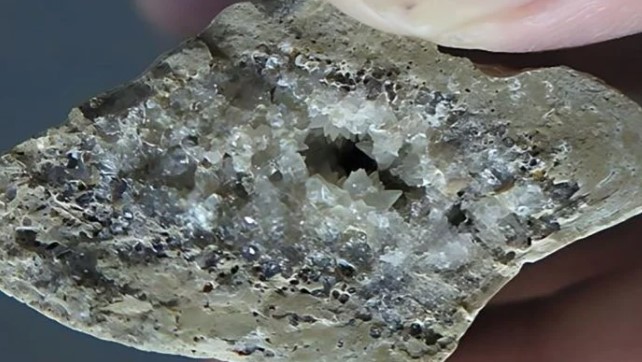
Crystals preserved inside a prehistoric bone led scientists to revise the estimated age of the archaeological site, suggesting that its stone tools were crafted during a severe ice age.
In central China, scientists have spent more than a decade excavating and studying an archaeological site where ancient humans processed animal remains. Among the bones, archaeologists uncovered complex stone tools that point to notable intelligence, planning, and creativity.
A new analysis of crystals that formed inside one of the bones shows that the site dates back to an ice age 146,000 years ago, challenging the long-held idea that creativity at the site emerged during warmer, more abundant times.
“People often imagine creativity as something that flourishes in good times,” says Yuchao Zhao, the assistant curator of East Asian archaeology at the Field Museum in Chicago and the lead author of a paper describing the findings in the Journal of Human Evolution. “Finding out that these stone tools were made during a harsh ice age tells a different story. Hard times can force us to adapt.”
Ancient tools challenge old assumptions
Zhao and his colleagues, working under senior author Zhangyang Li, a professor at Shandong University in China, have been studying stone tools recovered from the Lingjing archaeological site in central China. The site was occupied by early humans known as Homo juluensis. These ancient people were relatives of modern humans (Homo sapiens), and they may have encountered our ancestors. Homo juluensis had an unusual combination of traits, including very large brains and features seen in both eastern Asian archaic humans and European Neanderthals.
Until recently, many archaeologists believed that ancient humans in East Asia during the late Middle Pleistocene (300,000-120,000 years ago) showed fewer major technological developments than early humans in Europe and Africa. The tools from Lingjing are now complicating that view.
Stone cores reveal careful planning
At first, the disc-shaped stone cores from Lingjing may not seem remarkable. However, Zhao and his colleagues found that they were produced through a deliberate and organized tool-making process. Homo juluensis made them by striking small stones against larger stone cores.
Some cores were shaped in a fairly balanced way on both sides. Others show a more advanced design. One side was mainly used as the striking surface, while the other was shaped to produce sharp flakes. These uneven cores matter because they indicate that ancient humans were not simply breaking stone pieces at random. They treated the core as a three-dimensional object, assigned different functions to different surfaces, and controlled the angles needed to keep making useful flakes.
“This was not casual flake production, but a technology that required planning, precision, and a deep understanding of stone properties and fracture mechanics,” says Zhao. “The underlying logic of this system— and the cognitive abilities it reflects— shows important similarities to Middle Paleolithic technologies often associated with Neanderthals in Europe and with human ancestors in Africa, suggesting that advanced technological thinking was not limited to western Eurasia.”
The stone artifacts left by Homo juluensis at Lingjing therefore suggest that these early humans were capable of sophisticated thinking and creative problem solving. New dating work has added another layer to the story by changing estimates of when the tools were made.
Bone crystals reset the timeline
Lingjing served as a place where Homo juluensis butchered animals such as deer, and those animal bones were found alongside the stone tools. One rib from a deer-like animal held sparkling calcite crystals. Calcite crystals contain tiny amounts of uranium, which slowly breaks down into thorium. By comparing the amounts of uranium and thorium in a calcite crystal, scientists can estimate the crystal’s age.
The calcite crystals inside the bone acted like a natural clock, allowing us to refine the age of the site,” says Zhao.
Earlier work suggested that the Lingjing tools were no more than about 126,000 years old. The crystals now indicate that they are roughly 20,000 years older, a relatively small shift in time that changes the interpretation of the site.
“Even though these tools are just a little bit older than we’d previously thought, the entire story is changed,” says Zhao. “During the Pleistocene, Earth repeatedly shifted between colder ice-age periods and warmer intervals between them. We used to think these tools were made 126,000 years ago, during a warm interglacial period, but based on the new dates suggested by the crystals, some of these tools were actually produced 146,000 years ago, during a harsh, cold glacial period.”
The revised age of these stone artifacts challenges the idea that creativity is mainly a product of favorable conditions. At Lingjing, it may instead have been an adaptation to difficult conditions. “Altogether, this research reveals a much richer story of innovation, intelligence, and human evolution in East Asia,” says Zhao.


comments


Other categories
Recent Comments