


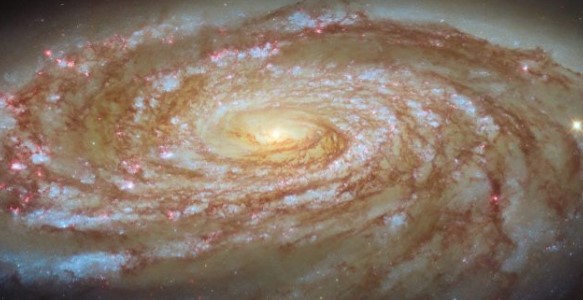
A spectacular spiral galaxy known as M88 is traveling toward the crowded heart of the Virgo Cluster, where powerful forces are already beginning to reshape its future.
A striking new image from the NASA/ESA Hubble Space Telescope highlights Messier 88 (M88), a spiral galaxy that is in the midst of a cosmic journey spanning hundreds of millions of years. Also known as NGC 4501, M88 lies roughly 63 million light-years from Earth in the constellation Coma Berenices (Berenice’s Hair).
A Spiral Galaxy Powered by a Supermassive Black Hole
M88 is classified as an active galaxy because a supermassive black hole at its center is actively consuming surrounding gas and dust. Astronomers estimate that this black hole contains about 100 million times the mass of the Sun. As material falls inward, the black hole appears to drive streams of gas outward from the galaxy’s core.
Surrounding the central black hole is a population of older, reddish stars that give the galaxy’s center a warm glow. Extending outward are several tightly wound and remarkably symmetrical spiral arms. These arms are traced by bright pink and blue star clusters as well as dense clouds of dust. Because M88 is viewed at an angle from Earth, the galaxy appears stretched, allowing its graceful spiral structure to fan outward across the image.
M88’s Long Journey Through the Virgo Cluster
M88 is one of more than a thousand galaxies that belong to the Virgo Cluster, a vast collection of galaxies bound together by gravity. Although the cluster moves through space as a single system, its member galaxies are constantly orbiting around the cluster’s center of gravity.
For M88, that motion is carrying it on a lengthy and potentially transformative path toward the cluster’s inner regions.
Its destination lies about two million light-years from its current position. Along the way, the galaxy will undergo major changes that could reshape its future. Astronomers predict that in 200–300 million years, M88 will pass closest to Messier 87, the enormous elliptical galaxy that dominates the Virgo Cluster.
Signs of a Galaxy Being Stripped of Star-Forming Gas
As M88 approaches this massive gravitational powerhouse, it will experience intense ram pressure stripping. This process occurs when a galaxy travels through the hot gas that fills a galaxy cluster, causing its own gas to be swept away.
Evidence suggests that this transformation has already begun.
Researchers have observed that M88’s rotating gas disk appears truncated and compressed along the galaxy’s leading edge. Gas and dust are being pushed together in a way that resembles snow piling up in front of a plow. Observations also show that M88 contains significantly less cold gas than astronomers would expect for a galaxy of its size, particularly in its outer regions.
Cold gas serves as the raw material for star formation, and its loss is a strong indication that M88’s ability to create new stars will decline over time. As the galaxy continues its journey through the Virgo Cluster, these changes are expected to influence both its evolution and its long-term future.
Hubble Studies Galaxy Evolution in Crowded Environments
Astronomers observed M88 as part of a Hubble observing program (#18103; PI: D. Thilker) focused on understanding how spiral galaxies evolve in dense cosmic environments.
The project uses Hubble’s Wide Field Camera 3, an instrument capable of resolving individual star clusters and nebulae in galaxies located tens of millions of light-years away. By examining galaxies in such detail, researchers can better understand how travel through a crowded galaxy cluster affects star formation and drives long-term galactic evolution.


comments


Other categories
Recent Comments