


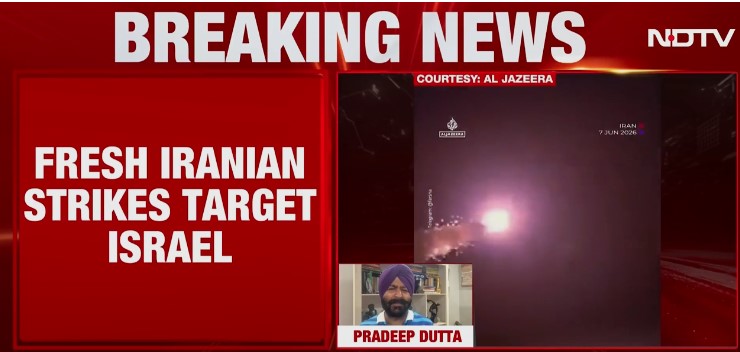
The attack came a day after Tehran warned of retaliation after Israel struck Beirut's southern suburbs without warning on Sunday in defiance of Washington's request days ago to stand down.Tel Aviv:
Israel has launched airstrikes targeting central and western Iran in response to missile fire from Tehran, raising the possibility of a return to heavy fighting and complicating mediation efforts to reach a potential deal to end the US-Israeli war with Iran. Tehran's IRNA news agency reported that at least "two powerful explosions" were heard in Tehran and at least three explosions were heard in the cities of Isfahan, Karaj and Tabriz.
Later, the Israeli army said it struck a petrochemical plant in Iran's Mahshahr. Iran's Revolutionary Guard said they retaliated by launching attacks on the Israeli air bases at Nevatim and Tel Nof.
Iran closed the airspace around Tehran's Imam Khomeini International Airport, the country's main airfield, after the Israeli attack. Data from Flightradar24 showed civil airspace emptied from Israel to Iran as Tehran and Tel Aviv traded strikes.
Tehran has also warned that all US bases in the Gulf are being considered legitimate targets by Tehran as Israel continues attacks on its territories, according to news agency Reuters.Israeli attacks came in retaliation after Iran's first strikes targeting Israel since a fragile ceasefire took effect in early April. The attack came a day after Tehran warned of retaliation after Israel struck Beirut's southern suburbs without warning on Sunday in defiance of Washington's request days ago to stand down.
Iranian officials offered no details on what had been struck, nor any damage information. Iran's paramilitary Revolutionary Guard said that Israel used air-launched ballistic missiles in its attack Monday morning, without elaborating.
The Israeli military at dawn in Iran issued a short statement as the strikes started, “A short while ago, the Israeli Air Force struck military targets belonging to the Iranian terror regime in western and central Iran.” It did not elaborate.
Israel Threatens Retaliation
In Israel, sirens were sounded in several areas, sending millions running for shelter. Israel's military said it intercepted the missiles from at least three barrages as multiple explosions were heard in the north. According to a CNN report, at least 10 ballistic missiles had been intercepted.
Trump's Warning To Israel
Israeli attacks complicate things for Iran and US negotiations, as Israel's public broadcaster, Kan, reported that US President Donald Trump told it that he doesn't think Israel needs to respond further.
For days, negotiations between Iran and the United States over the fragile ceasefire in the war had been stalled by the fighting between Israel and the Lebanese Shiite militia Hezbollah. Israel now occupies southern Lebanon and has moved into areas of the country it hadn't held in a quarter century — leading to fears about it further widening its campaign.
American publication Axios also reported that Trump told Israeli Prime Minister Benjamin Netanyahu not to retaliate against Iran's missile attack and allow more time for diplomacy. The US president himself told the publication before the call that he planned to urge Netanyahu not to retaliate against Iran's missile attack, which Tehran said was a response to an Israeli strike in Beirut.
A senior US official also told Axios the Trump administration didn't give a "green light" to the Israeli strike in Beirut.
Trump's effort to restrain an Israeli response signals his administration's push to keep escalating Israel-Iran tensions from derailing ongoing U.S. negotiations with Tehran.
Israel's Attack On Lebanon And Iran's Warning
Iran had warned that an attack on Beirut would renew full-scale war across the Middle East, even as Pakistan and other mediators try to restart talks between Tehran and Washington. "US forces across the Middle East remain vigilant and ready," the US Central Command posted on X shortly before the missile launches.
Israel's attack on Beirut came a few days after the Lebanese and Israeli governments agreed to a ceasefire in US-hosted talks, though Hezbollah rejected the deal. The strike on a residential building killed two people and wounded 20, Lebanon's health ministry said.
"The army will continue to act in all of Lebanon," the Israeli military spokesperson said.
Israel's strikes and ground invasion in Lebanon in pursuit of Hezbollah, and the militant group's resistance to disarming, have complicated an overall deal to end the war in the Middle East. Iran says any deal must include an end to fighting in Lebanon.


comments


Other categories
Recent Comments