


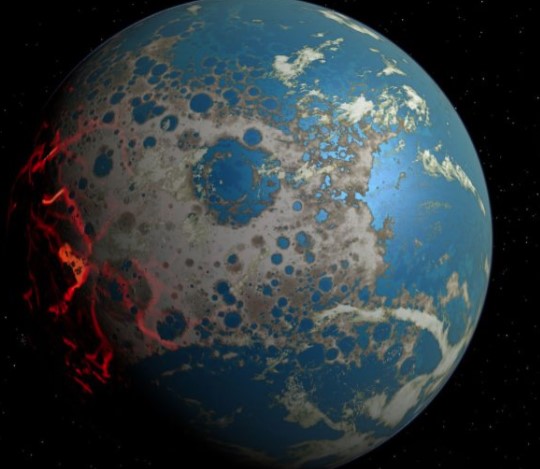
Ancient asteroid impacts may have done more than reshape Earth’s surface.
For decades, asteroid impacts have been viewed mainly as agents of destruction. But on the young Earth, they may have done something far more surprising: helped create some of the planet’s first habitable environments.
A new study from Southwest Research Institute (SwRI) suggests that the same cosmic collisions that repeatedly battered Earth more than 4 billion years ago may have transformed large portions of the crust into vast underground networks where hot water could circulate. These hydrothermal systems are considered some of the most promising settings for the chemical reactions that eventually led to life.
Using advanced computer simulations, researchers found that impacts could fracture enormous volumes of rock, creating pathways for water to penetrate deep into the crust. Combined with heat from both the impacts themselves and Earth’s interior, these fractured regions may have functioned like giant natural reactors, potentially supporting prebiotic chemistry on a planetary scale.
“This modeling is both novel and crucial for understanding the earliest environments life may have emerged from,” said SwRI’s Amanda Alexander, first author of an AGU Advances article about this research. “While often considered catastrophic in the context of dinosaur extinction, impact bombardment was also likely critical for creating environments for prebiotic chemistry.”
Reconstructing Earth’s Violent Early History
Earth formed roughly 4.5 billion years ago during a chaotic era when collisions with asteroids and other planetary debris were commonplace. At the time, the planet lacked the stable surface environments familiar today. Instead, its crust was repeatedly shattered by impacts ranging from relatively small strikes to continent-scale events.
Scientists have long known that these collisions excavated massive craters and melted large amounts of rock. What has been less clear is how effectively impacts altered the crust beneath the surface and how long those changes persisted.
To answer that question, the SwRI team used a sophisticated shock physics model capable of tracking how impacts crack solid rock and generate porous zones. The simulations examined asteroids of different sizes and velocities, along with varying crust compositions and temperature conditions. Researchers then calculated how much permeable rock each impact produced and how easily fluids could move through it.
Massive Hydrothermal Activity Driven by Impacts
Hydrothermal systems form when water interacts with hot rock, creating chemically active environments rich in dissolved minerals. Many scientists consider such settings strong candidates for the origin of life because they can provide energy sources, chemical building blocks, and stable conditions for complex reactions.
Today, Yellowstone National Park offers one of the best-known examples of hydrothermal activity. The new study suggests that individual impacts on early Earth may have generated hydrothermal systems up to 100 times more extensive than those found in the Yellowstone region today.
Rather than creating isolated pockets of activity, repeated impacts may have transformed large sections of the planet’s upper crust into interconnected networks of hot, circulating groundwater. Such environments could have dramatically increased the number of locations where life-friendly chemistry might occur.
“Because life could have originated or evolved in hydrothermal environments, it is important to understand and quantify the generation of these systems by impacts on the early Earth,” Alexander said.
A More Permeable Earth
The simulations revealed that the size of the permeable zones depended largely on the energy of the impact, which is determined by the asteroid’s size and speed. However, the extent to which those regions remained open to fluid circulation was influenced by factors such as crust composition and Earth’s geothermal gradient.
The researchers also incorporated estimates of how frequently impacts occurred during Earth’s early history. The results point to a world that may have been far more permeable than previously appreciated.
“Using a bombardment history model to infer the cumulative effects of recurring impacts, we estimate that the upper 5-mile (8-kilometer) shell of the Earth’s crust likely was highly permeable 4.3 billion years ago and that a significant portion of this volume may have remained permeable until 3.5 billion years ago,” Alexander said.
That timespan is particularly intriguing because it overlaps with the period when the earliest evidence for life begins to emerge in the geologic record. While the study does not show that impacts directly created life, it suggests they may have helped establish and maintain the environments where life had the opportunity to gain a foothold.
“These results show that impacts were instrumental in driving hydrothermal changes to the early Earth’s crust, with important consequences for the geochemical evolution of near-surface environments,” Alexander said.


comments


Other categories
Recent Comments