


Twenty rebel TMC MPs have claimed a merger with a little-known party, triggering a fresh legal battle over the anti-defection law's merger exception.
Twenty rebel Trinamool Congress lawmakers declared to the Lok Sabha Speaker on Sunday that they had merged with a party that holds not a single seat anywhere in India.
The move, apparently to avoid triggering the anti-defection law, has become one of its contested clauses. It was the second time this question was raised this year, just weeks after seven Aam Aadmi Party MPs made a near-identical move in the Rajya Sabha.
Whether the gambit holds will depend less on political arithmetic and more on a legal question the Supreme Court has yet to definitively answer: can a group of legislators declare a merger on their own, or does the political party they represent have to agree?
What the anti-defection law is, and what it permits
India’s anti-defection law was introduced through the Tenth Schedule to the Constitution, which came into force via the 52nd Constitutional Amendment in 1985. It was a response to the phenomenon of “aaya Ram, gaya Ram” politics — legislators switching parties mid-term to bring down governments or secure personal advancement.
The Tenth Schedule disqualifies any legislator who voluntarily gives up party membership or votes against their party’s directive in the House.
The law carved out two original exceptions. The first was a “split”: if one-third of a legislature party broke away, the rebels were shielded from disqualification. This provision, however, was stripped out by the 91st Constitutional Amendment in 2003, having been routinely gamed to engineer departures under the appearance of a formal split.
What survived is a single exception: merger. Paragraph 4 of the Tenth Schedule lays down the terms. Disqualification will not apply if the original political party merges with another party, and at least two-thirds of the members of that party's legislature group agree to such a merger. Two conditions, the law’s language suggests — a decision at the level of the political party, and legislative endorsement of at least two-thirds strength.
Twenty MPs, one obscure party
The Trinamool Congress’s crisis follows the party's defeat in the West Bengal assembly election, which produced the BJP's first-ever government in the state. The rebellion inside the parliamentary group surfaced quickly.
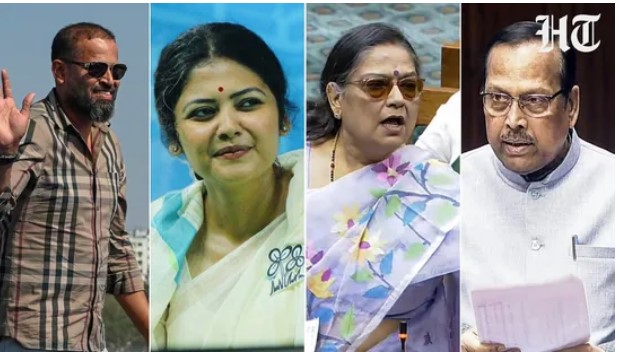
Kakoli Ghosh Dastidar, who was dropped from the chief whip's post, emerged as a leading rebel face. She was joined by former floor leader Sudip Bandopadhyay, deputy leader Shatabdi Ray, and a cross-section of the party’s Lok Sabha contingent that included actors Deepak Adhikari, Saayoni Ghosh and June Maliah, former cricketer Yusuf Pathan, and former Indian football captain Prasun Banerjee, among others.
On Sunday, nineteen of the rebels presented their letters in person to Speaker Om Birla. A twentieth, Rachana Banerjee, submitted her consent with a letter from Malaysia.
Together, they told Birla they had merged with the Nationalist Citizens Party of India, or NCPI — a party registered in 2022, which last contested elections in 2023 and currently holds no elected seat at any level.
A BJP MP involved in the discussions told HT that NCPI was selected to preserve the rebels’ connection to West Bengal while extending a symbolic reach to the Northeast.
The practical consequences, if the merger is approved, are significant. The TMC’s Lok Sabha strength would fall from around 28 to eight. In the Rajya Sabha, the party has already dropped from 13 to 10 seats. The NDA’s Lok Sabha count would rise from 294 to 314 — still 46 seats short of a two-thirds majority, though the alliance would be within eight seats of that threshold in the Upper House.
Mamata Banerjee’s TMC on Sunday took its own measures. TMC Lok Sabha floor leader Abhishek Banerjee wrote to the Speaker, arguing that “split is no longer available under the Tenth Schedule” and that the TMC remains “a single, indivisible political party”.
He cited the Supreme Court’s 2023 ruling in the Maharashtra political crisis — which drew a sharp distinction between a political party and its legislative wing — to argue that no group of members can carve out a parallel faction and claim independent recognition in the House.
The TMC leadership signalled it may approach the courts, mirroring the legal challenge AAP after seven party MPs joined the BJP in April.
The legal debate
At the centre of both the AAP and TMC disputes lies a constitutional question the Tenth Schedule does not resolve cleanly: does Paragraph 4 require an actual decision by the political party to merge, or does a two-thirds legislative bloc suffice on its own?
The language of Paragraph 4 references the “original political party” — the broader organisation, not just its elected representatives in a House. Paragraph 4 draws a structural distinction between the two: a political party fields candidates and issues whips; a legislature party is those candidates once elected. Treating them as interchangeable would mean legislators could effectively sever ties with the party that sponsored their mandate while claiming constitutional immunity.
The 2023 case
The Supreme Court weighed in on adjacent terrain in Subhash Desai versus Principal Secretary, Governor of Maharashtra in 2023. The case, which arose from the Maharashtra political crisis, did not directly involve a merger claim, but the court drew a line: a legislature party cannot act independently of the political party.
The court held that the Tenth Schedule draws a “clear demarcation” between the two, and that a legislative majority cannot determine the identity or decisions of the political party. If legislators cannot appoint a rival whip or claim a party’s identity by sheer numbers, it follows — by the same logic — that they cannot unilaterally effect a merger either.
Despite this, the legal position is not settled.
In 2022, the Bombay High Court upheld a claimed “merger” arising from defections in Goa on the ground that two-thirds of the legislature party had joined another party — without requiring proof that the original political party had itself taken a decision to merge.
This interpretation, currently challenged before the Supreme Court in Girish Chodankar versus Speaker, Goa Legislative Assembly, treats Paragraph 4(2) as a self-contained provision, making the two-thirds legislative threshold the sole qualifying condition.
Critics argue this reading drains the merger exception of its constitutional purpose and converts it into a formal licence for organised defection.
The Supreme Court’s ruling in the Chodankar case — still pending — is expected to determine whether Paragraph 4 must be read conjunctively, requiring both a party-level merger decision and legislative endorsement, or disjunctively, where legislative numbers alone suffice. The TMC rebellion, unfolding in real time at parliamentary scale, adds considerable urgency to that determination.
The Speaker’s role
In the immediate term, the TMC rebels’ fate rests with Lok Sabha Speaker Om Birla. He will verify the signatures of the 20 MPs before adjudicating on the merger claim. The Speaker — or the Rajya Sabha Chairman in parallel proceedings involving AAP — functions as the first constitutional authority on disqualification questions, with courts reviewing those decisions, not substituting them at first instance.
Until a ruling comes, the rebels occupy a legally anomalous position: they continue to belong, on paper, to the party on whose ticket they were elected. That means they remain subject to TMC’s whip — and could face additional grounds for disqualification if they vote or act against it during the intervening period. The Tenth Schedule sets no time limit within which a Speaker or Chairman must decide disqualification petitions, a gap that allows such ambiguity to persist through legislative proceedings of consequence.
If the 2003 removal of the split provision was meant to tighten the law, the merger exception has increasingly become the opening through which organised defections seek to pass. The AAP episode in April was one test. The TMC rebellion — 20 lawmakers, a party with no MPs, and an NDA-aligned government in waiting — is another.
Senior lawyer and independent MP Kapil Sibal was more direct: “The rebels of the TMC legislative party cannot merge with a political party; that can happen only if the TMC wished to do so. Disqualify them.”


comments


Other categories
Recent Comments