


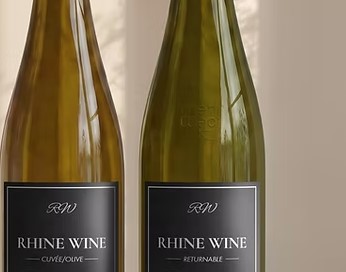
Vetropack has developed what it claims is the lightest Rhinewine bottle in Europe, alongside a reusable variant that supports the recently introduced reusable wine bottle system in Austria.
The latest innovations from the glass packaging manufacturer aim to boost environmental sustainability in the Austrian wine industry.
Vetropack’s latest development of the classic 750ml Rhinewine bottle significantly reduces its weight to just 350g while retaining the same dimensions. This reduced bottle weight lowers CO2 emissions throughout the supply chain, while also cutting material, logistics and licensing costs.
This is particularly relevant for export markets with weight restrictions on glass packaging. The lightweight bottle is also made from around 80% recycled glass, Vetropack said, noting that regional production in Austria further improves its environmental footprint due to shortened transport routes.
Compared with a traditional Rhinewine bottle, the bottle generates 33g, or 13%, less CO2 over a transport distance of 100km according to Vetropack. It is available in olive and cuvée, and retains the bottle’s familiar shape without compromising on functionality.
Vetropack’s Harald Geist said: “Reducing the weight of a 750ml Rhine wine bottle to 350g is a significant technological achievement. The key was working closely with our technical teams to develop a solution that not only meets the mechanical requirements of our customers’ bottling and logistics processes but also delivers an attractive appearance.”
Meanwhile, following a two-year development phase, a pooling scheme for reusable wine bottles is being launched in Austria, led by the Austrian Ecology Institute in collaboration with winegrowers and key stakeholders.
Vetropack is already producing new returnable Rhinewine bottles at its Pöchlarn site. The olive-green bottle has been available to all businesses participating in the pool scheme since spring 2026.
With a height of 340mm, the bottle is optimised for efficiency in logistics and can be stacked up to four layers high. A four-sided reusable embossing is designed to ensure the bottle remains clearly identifiable.
The bottle is also the first reusable wine bottle with a BVS finish to be produced in Austria. This reinforced, specially developed neck ensures the robustness required for reusable cycles and industrial filling processes.
The first market participants are already using the system, with Vetropack confirming the solution is also attracting interest in neighbouring countries. A matching six-pack crate is expected to be launched in July.
Geist commented: “With the pool solution, winegrowers now have access for the first time to an elegantly designed, reusable wine bottle that is particularly well-suited to direct sales or use at green events”.
“In addition to CO2 savings of up to 90% across the value chain, users also benefit from standardised processes, for example in cleaning and logistics.”


comments


Other categories
Recent Comments