


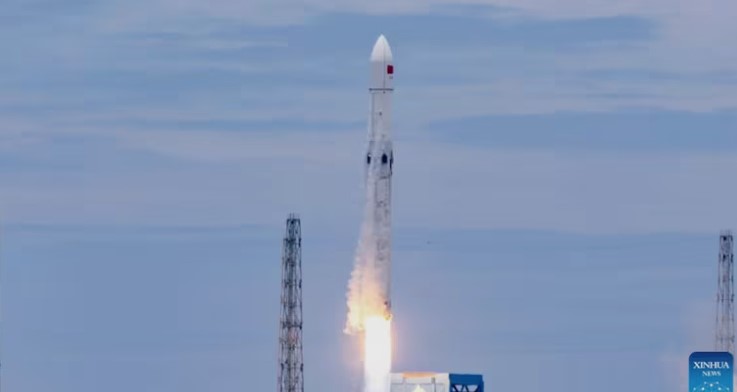
The Long March-10B carrier rocket, a reusable liquid-fueled commercial launch vehicle, stands approximately 63 meters tall with a diameter of five meters.
China achieved major milestone on Friday after it successfully tested an experimental rocket retrieval system. China launched the Long March-10B rocket at noon and within minutes, the first stage or booster returned, making it the country's first controlled recovery of a carrier rocket.
The rocket lifted off from the Hainan commercial space launch site in southern China at 12:15 pm (0415 GMT). About six minutes after separation of its booster and upper stage, the booster returned vertically and was recovered on an offshore seaborne platform via net-capture system, state broadcaster CCTV reported.
Both the launch and the first-stage recovery were successfully completed, China's Xinhua news agency reported.
"This mission marked China's first successful controlled recovery of a carrier rocket's first stage, representing a major breakthrough in the country's reusable rocket technology," the news agency added.
Reusability allows companies to refly the most expensive parts of the rocket.
Long March-10B vs Falcon 9
The Long March-10B carrier rocket, a reusable liquid-fueled commercial launch vehicle, stands approximately 63 meters tall with a diameter of five meters. It has a liftoff thrust of about 890 tonnes and a liftoff mass of approximately 760 tonnes. In its reusable configuration, it has a low Earth orbit (LEO) payload capacity of 16 tonnes.
China's Long March-10B is often compared to the SpaceX's Falcon 9, a reusable, two-stage rocket designed and manufactured for the reliable and safe transport of people and payloads into Earth orbit and beyond.
The Falcon9 is 70 meters tall with a diameter of 3.7 meters. It has a mass of over 5.49 lakh kg with a payload to LEO of 22,800 kg.
SpaceX landed a Falcon 9 rocket from an orbital flight for the first time in December 2015, followed by Blue Origin's New Glenn in November 2025.
According to a Reuters report, SpaceX's Falcon 9 launches around 150 times a year, or roughly thrice a week, with its booster reused dozens of times if necessary.
Why Long March-10B's Launch Is No Mean Feat
China has spent nearly a decade developing reusable rocket technologies. Two attempts by private Chinese firm LandSpace and state-owned China Aerospace Science and Technology Corporation last year failed to complete the crucial final step of landing and booster recovery.
China plans to use the Long March 10's booster stage again for another launch by the end of this year.


comments


Other categories
Recent Comments