


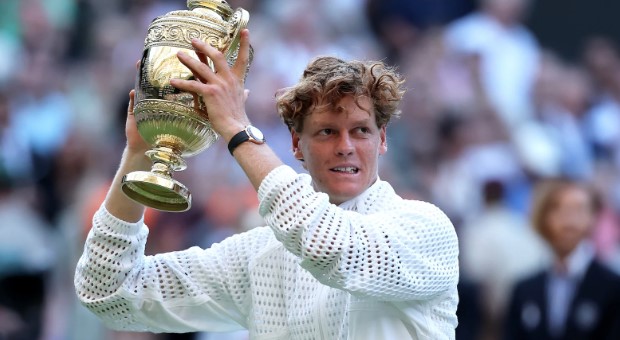
Jannik Sinner beat Alexander Zverev 6-7, 7-6, 6-3, 6-4 in the Wimbledon 2026 men's singles final. At the age of 24, Jannik Sinner has won 5 Grand Slam titles
The modern tennis landscape is being shaped by two talismanic players: Jannik Sinner and Carlos Alcaraz. While Novak Djokovic still has what it takes to go the distance, Sinner and Alcaraz are the two dominating the sport at the moment, with Alexander Zverev showing a late surge to remain part of the discussion. With Alcaraz out injured, Sinner showed his class yet again, winning his second consecutive Wimbledon title by beating Germany's Zverev in the final. The ease with which Sinner outlasted Zverev in the decider on Sunday has made even the most ardent fans of the sport dig deep into his playing style, shots,, and the weapons the Italian stores in his arsenal.
Usually, tennis has been a sport dominated by two distinct physical archetypes. In today's times, on one hand, there is Carlos Alcaraz, a Spaniard with explosive athleticism capable of turning a casual rally into a chaotic sprint. On the other is Novak Djokovic, the ultimate rubber band, whose historic elasticity allows him to slide into extreme corners, bend his frame, and absorb an opponent's best shot. Jannik Sinner is neither of these.
Instead, the World No. 1 has carved out his place at the pinnacle of men's tennis by operating in a zone that can be called "controlled violence." Sinner does not rely on heavy topspin arcs or defensive scrambling to win matches. The secret to his match-winning ability lies in a structurally flawless, mechanical baseline game that is extremely tricky for an opponent to counter.
What Makes Jannik Sinner Special?
Where Sinner truly separates himself from other top players is his positioning and contact point. He stands glued to the baseline, taking the ball remarkably early on the rise. By meeting the ball at its apex before it can push him back, Sinner completely suffocates his opponents. There is no comfortable place on the court to escape his pace. Almost every return comes back heavy and faster than the last, forcing rivals into a state of panic from which they can't recover.
Not only that, but Sinner has also solved a tactical puzzle in tennis that even the greatest in history have struggled with. Most elite players possess a dominant weapon and a vulnerable side that opponents often look to exploit under pressure.
Sinner, however, generates blistering, flat power with equal lethality on both his forehand and backhand-a combination that remains unmatched even after decades of evolution and sports science in the sport.
This symmetrical weaponry gives him the edge by altering the geometry of the rally. Opponents cannot hide the ball cross-court or look for a safe haven when trying to find an escape route.
More than the physical attributes of his game, what truly makes Sinner a weapon is his psychological mindset. Underneath the thunderous groundstrokes lies a quiet, razor-sharp focus that aids him in high-pressure situations.
He rarely shows frustration or panics when a tactic fails. This emotional neutrality allows him to stick to his game plan even when the opponent is in a dominant position. Sinner doesn't need to explode like Alcaraz or stretch like Djokovic to win games. For him, the key is being a cold, calculating machine that slowly but inevitably grinds down the opposition.


comments


Other categories
Recent Comments