


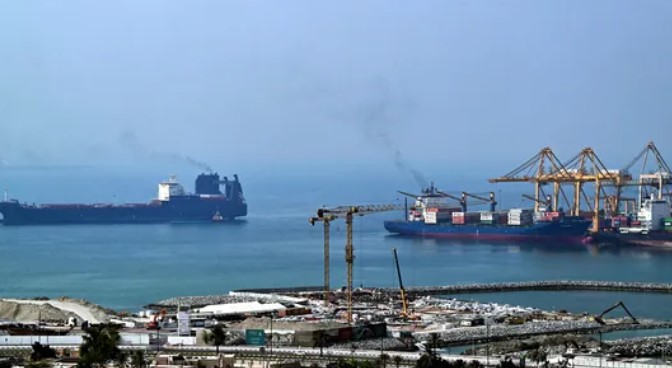
The move comes amid an escalating maritime security crisis in West Asia following attacks on two merchant vessels in the Strait of Hormuz.
Emphasising the welfare of seafarers amidst escalating maritime security crisis in West Asia, the Centre on Tuesday launched a comprehensive "Seafarer-First" response that will account for every Indian on every vessel, irrespective of their flags, operating in the Persian Gulf, Strait of Hormuz and Gulf of Oman.
The announcement comes after an Indian seafarer, identified as Rohan Kumar, was killed after two Emirati oil tankers came under missile attack in the Strait of Hormuz.
Union Minister for Ports, Shipping and Waterways Sarbananda Sonowal said the initiative adopts a whole-of-government approach to ensure the safety and welfare of Indian crew members in the sea.
He directed the Directorate General of Shipping (DGS) to establish a comprehensive vessel-by-vessel operational dashboard to account for every Indian on every vessel, irrespective of their flags, operating in the Persian Gulf, Strait of Hormuz and Gulf of Oman.
Also Read: How many Indian seafarers have been killed since US-Iran war began? A timeline
The dashboard will provide real-time information on vessel position, ownership, cargo, crew strength, crew welfare, threat assessment, intended voyage, next port of call and the availability of facilities, according to the government press release.
The move comes amid an escalating maritime security crisis in West Asia following attacks on two merchant vessels in the Strait of Hormuz. MT Al Bahiyah and MT Mombasa together carried 30 Indian seafarers among a combined crew of 46. One Indian seafarer was killed and another injured aboard MT Al Bahiyah, while nine Indian nationals on MT Mombasa were injured, including two who remain in serious condition.
At a meeting attended by Union Minister of State for Ports, Shipping and Waterways Shantanu Thakur and senior officials from the Ministry of Ports, Shipping and Waterways, the Ministry of External Affairs, the Indian Navy, the Directorate General of Shipping, Indian missions in Iran and Oman, and other maritime agencies, Sonowal reviewed the security situation in the Persian Gulf, the Strait of Hormuz and the Gulf of Oman, and India's contingency measures for Indian seafarers.
As part of the response, he ordered real-time vessel monitoring, appointed liaison officers for every affected Indian seafarer, and directed round-the-clock coordination among the ministries concerned, the Indian Navy, the Directorate General of Shipping (DGS), and Indian missions in Iran and Oman.
Sonowal expresses grief
Expressing grief over the attacks, Sonowal condemned the targeting of civilian merchant vessels, saying the government would extend all possible support to the affected seafarers and the families of those killed or injured.
“India has expressed its strong resentment and objection to the manner of attacks on defenceless civilian merchant vessels. These have resulted in the death and serious injury of Indian seafarers who, as key workers ensuring the proper functioning of global supply chains, due to these irresponsible, unwarranted and uncalled-for attacks.”
“I am profoundly hurt and aggrieved by the unfortunate and tragic loss of one more of our brave and innocent seafarers along with the injuries suffered by others in today’s two attacks. I convey my heartfelt condolences to the bereaved family and prayers to the Indian seafarer who made the ultimate sacrifice in the line of duty. We shall ensure that our seafarer’s families are supported and cared for. I want to assure every Indian seafarer and their family that the entire Government is committed to assist you in every possible way, and at all costs,” he added.
Dedicated liaison officer for families affected
A dedicated liaison officer will be appointed for every Indian seafarer impacted by the crisis to ensure uninterrupted assistance to affected families.
Each liaison officer will serve as the single point of contact for families, coordinating medical updates, travel documentation, family assistance, repatriation, Seafarers Welfare Fund support, outstanding wages, contractual entitlements and other compensations, as per the release.
Coordination with Indian missions internationally
The minister directed officials to coordinate with Indian missions in Iran, Oman and the United Arab Emirates, other affected countries, and the Ministry of External Affairs to obtain real-time information on navigational safety, coastal advisories, shipping routes, port-of-refuge arrangements, medical evacuation, repatriation, management of mortal remains, and the status of ongoing investigations.
“The Government of India has communicated with all the multilateral forums of the IMO and also with the representatives of the concerned flag administration involved in the multiple incidents that contravened international conventions and fundamental requirements of seafarer’s security and safety and protection of right of innocent passage for merchant vessels. We will continue to make every effort to ensure resolution of the issues and remain committed to all stakeholders in this trying and challenging time,” said Sonowal.
Vessels to coordinate with maritime authorities
Sonowal directed that every vessel transiting the conflict-affected region undertake a fresh threat assessment, with voyages proceeding only after the ship master's professional judgement and in coordination with the relevant maritime authorities.
He also asked shipowners, vessel managers and Recruitment and Placement Service Licence (RPSL) agencies employing Indian seafarers in the region to submit compliance reports confirming that no Indian crew member is being compelled to sail without adequate information, protection and support.
The government has also activated a 24x7 grievance support system for Indian seafarers and their families. Assistance is available through domestic and international toll-free helplines, WhatsApp and email.
Sonowal reaffirmed that the government's response would remain "seafarer-first", with coordinated efforts across ministries and maritime agencies to protect Indian seafarers and ensure the uninterrupted movement of global trade through the region.


comments


Other categories
Recent Comments