


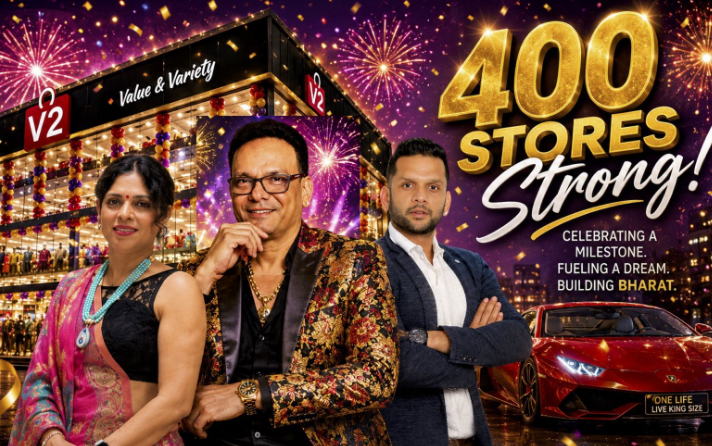
I have known Ram since the late 1990s. Over the years, I have heard him tell stories of ambition, failure, reinvention and retail with the same infectious confidence. Today, even the way he lives and dresses seems to tell the story of the man.
There are entrepreneurs you remember for the businesses they built and there are others you remember for the personality they brought into the room. Ram Chandra Agarwal has always belonged to the second category. I have known Ram since the late 1990s, when organised retail in India was still finding its feet, and what has stayed with me over the years is not simply what he built, but the man himself—his extraordinary self-belief, restless energy, ability to make an ordinary conversation sound like a declaration of intent, and his seemingly permanent tendency to think bigger than the circumstances around him. I have heard him narrate his journey many times, including at Images Fashion & Retail conventions and other Images platforms, and his stories were always as much about Ram as they were about business.
Today, his digital presence provides a wonderfully contemporary expression of that personality. The colours are bold, the prints are adventurous, the jackets are impossible to miss, and the watches, shoes, sunglasses and other accessories are carefully chosen to make a statement. But his flamboyance does not stop with fashion. His social-media feed reveals a man equally comfortable in the gym, in luxury settings, at family gatherings or posing beside an exotic sports car. There are intense workout photographs, carefully styled casual wear, statement outerwear, designer blazers and photographs that project a distinctly larger-than-life lifestyle. Whether he is sweating through a workout, celebrating with family and friends or dressing up for a glamorous evening, there is very little of the conventional, buttoned-down Indian corporate personality about him.
I sometimes think Ram dresses, lives and presents himself exactly the way he has always done business—with confidence, colour and very little desire to disappear into the background.
THE RAM BEFORE VISHAL
The Ram Chandra Agarwal story is now usually compressed into a few familiar milestones: polio in childhood, crutches, a modest beginning, a photocopy shop, garments, Vishal Mega Mart, a spectacular rise, a painful collapse and then V2 Retail. But whenever Ram has narrated the story to me, it has never sounded like a conventional rags-to-riches biography. He tells it more like a collection of adventures, decisions, mistakes and lucky breaks, often with a touch of humour and the confidence of someone who has already lived through the difficult ending and therefore has nothing left to prove.
His first business was a photocopy shop in Kolkata. It did not take him long to realise that photocopying could provide a livelihood but was unlikely to satisfy his entrepreneurial appetite. He moved into garments and began learning retail from the only classroom that ultimately matters—the market. He watched customers, understood what they wanted, learnt how much they were willing to pay and discovered the enormous gap between what India's emerging middle class aspired to wear and what it could comfortably afford. That understanding became the foundation of his retail philosophy.
Ram has always had the ability to look beyond the individual customer in front of him and see the size of the market behind that customer. A garment bought by one family could represent millions of families; a successful shop could become a format; a format could become a chain; and a chain could become a national retail business. That instinct made him a formidable entrepreneur, although it would eventually also become one of the reasons he would have to reinvent himself.
WHEN AMBITION BECAME A HABIT
By the time Vishal Retail began taking shape, Ram was no longer thinking like the owner of a small garment shop. He was thinking in formats, scale and national reach. One store was never simply one store. If a format worked, he wanted to replicate it; if a market responded, he wanted to enter another; and if the opportunity looked large, he saw little reason to approach it cautiously.
I have heard Ram speak about those years many times, and there was always an impatience with incremental thinking. Why settle for one store if the proposition could work in ten? Why stop at one city if the consumer need existed elsewhere? Why build a business that could remain small when the opportunity was obviously much larger? That was the Ram who built Vishal, and when Vishal began to work, the ambition accelerated.
In one of the most revealing stories he has narrated about that period, Ram recalled how, at the height of Vishal's expansion, he would inaugurate four stores a week. He had also ventured into manufacturing, setting up factories because he believed he could manage that alongside the retail business. Looking back, he openly described overconfidence as one of his biggest mistakes. The organisation simply did not have the management bandwidth to absorb the speed at which he was expanding.
What makes the anecdote so revealing is that Ram does not tell it with the bitterness of someone blaming his circumstances. There is almost a sense of amusement when he looks back at the man he was then. He was ambitious, he was confident and, perhaps, he genuinely believed that if he could build one part of the business, he could build every other part as well.
THE MAN WHO WANTED TO DO EVERYTHING
In the early years, Ram had done almost everything himself. He has often spoken about starting with a small shop, selling from the counter, buying merchandise, dealing with suppliers and even looking after the accounts. When you build something from scratch, that is how entrepreneurs survive. But the same quality that helps build the first store becomes a constraint when there are dozens or hundreds of stores.
Ram learnt that lesson the hard way. He eventually realised that he could not personally select every product, supervise every store, manage every supplier, monitor every location and still run an organisation expanding at extraordinary speed. He has spoken about how Vishal needed a professional hierarchy, stronger systems and a management structure capable of carrying the business beyond the founder.
I remember hearing him explain this over the years, and it is one of the things that makes his story more interesting than the usual entrepreneurial tale of success and failure. Ram did not fail because he lacked ambition; if anything, he had more ambition than the organisation around him could absorb. His challenge was learning that entrepreneurial energy alone cannot substitute for institutional capability.
THE FALL THAT DID NOT END THE STORY
The collapse of Vishal Retail has been written about so often that the numbers have almost become part of Indian retail folklore. But numbers cannot describe what it must have felt like for an entrepreneur to see a business he had built from almost nothing disappear. Ram's first empire had risen rapidly, attracted capital and public attention, and then unravelled under the weight of aggressive expansion, debt and an unforgiving business environment.
What interests me is what happened afterwards. Ram did not leave retail, retreat into a quiet life or spend years explaining why somebody else was responsible. He went back into the same business. He started again, this time with V2 Retail, carrying with him the scars and lessons of Vishal.
That decision says more about the man than the size of either business. It is relatively easy to start something when everything is going your way. It requires a very different kind of confidence to return to the same industry after losing almost everything you built and say, in effect, “I know what went wrong; I can do it differently.”
Ram did exactly that.
THE SECOND RAM
V2 was not simply another retail company. It was Ram's second attempt to prove that his original instincts about value retail were right, but that his method of building the business had to change. There was greater emphasis on systems, professional management, productivity, merchandise planning and organisational capability. Ram had learnt that opening stores was the easy part; building an organisation capable of making those stores productive was the difficult part.
I remember the change in the way he talked about the business during those early V2 years. The conversation was less about how many stores he could open and much more about how well each store performed. He would talk about productivity, merchandise, inventory, locations and customer response with the intensity of someone who had already paid a very expensive tuition fee. The phrase “one step at a time” became particularly significant because it was almost the opposite of the Ram who had once been opening stores at extraordinary speed.
But the ambition underneath had not changed. He was still thinking big; he had simply learnt that big dreams need stronger foundations.
THE RETAILER IS STILL THERE
One of the things I have always enjoyed about Ram is that no matter how large the business becomes, the retailer in him remains remarkably close to the surface. Even when there was plenty of serious work to do around strategy, systems and organisation during the early V2 years, he could become completely absorbed in merchandise. Give him a garment and his instinct immediately took over: who would buy it, at what price, in which store, in which colour and whether the customer would see the value.
I remember one such moment from the V2 period that captures him perfectly. There were jacket samples in front of him, and while there were obviously much bigger questions on the table, Ram's attention went straight to the product. He looked at the jackets, assessed them and made the buying decision. It was retail reduced to its most basic form—product, customer and judgement.
That instinct has never disappeared. The flamboyant businessman we see today in colourful jackets and dramatic prints is, at heart, still the retailer who wants to know whether the customer will pick up the garment. Perhaps that is why his personal style feels so natural. Ram understands attention, colour, presentation and visual impact. He has spent a lifetime applying those instincts to retail; today, he occasionally applies them to himself.
AN UNFILTERED RETAIL MAVERICK
What is particularly striking about Ram today is how completely he breaks the mould of the conventional Indian corporate leader. His digital presence does not appear to have been manufactured by a communications agency trying to create a carefully sanitised promoter persona. It feels much more like Ram simply being Ram—high-energy, expressive and unapologetically himself.
The gym is another part of that picture. His workout posts show the same intensity that has characterised his approach to business, with focused routines, gym selfies and an obvious interest in maintaining physical fitness. There is a certain irony in watching a man who has spent decades talking about retail productivity bring the same intensity to his workouts. He appears to approach fitness with the same enthusiasm with which he approaches almost everything else.
Then there is the glamour. Ram is perfectly comfortable posing beside luxury sports cars, dressing in textured casual wear or statement outerwear, and turning up in heavily patterned designer blazers that most corporate leaders would probably consider too conspicuous. He seems to enjoy the theatre of it all. Whether he is at a family celebration, a social gathering or a formal event, there is little attempt to tone himself down.
For me, that is what makes the social-media images interesting. They are not simply photographs of a wealthy businessman enjoying the rewards of success. They reveal a personality that has always been expressive, ambitious and slightly larger than life. The Ram who once dreamed of building hundreds of stores is the same Ram who today appears perfectly happy to make a statement through a jacket, a car, a gym photograph or a pose with Uma.
RAM'S STORIES ARE PART OF HIS PERSONALITY
One of the pleasures of listening to Ram is that he rarely tells a business story as a dry business case. There is usually a person in it, a moment, a joke, a little exaggeration or some wonderfully blunt observation. At Images Fashion & Retail conventions, I have heard him speak with the same energy he brings to a private conversation. He can move from a serious point about retail strategy to an intensely personal anecdote and have an entire audience laughing, often without changing his tone.
That is an unusual quality. Many business leaders eventually learn to speak in polished corporate language, but Ram has retained the language of the entrepreneur who learnt his trade in the market. He speaks in stories because that is how he seems to remember things, and those stories often reveal more about his thinking than a carefully constructed presentation ever could.
His stories also have a distinctive Ram quality: they are rarely small. Even when the subject is a mistake, he can make it sound like an adventure. Even when the subject is a setback, there is usually a forward-looking element. He has an instinctive belief that the next chapter will be more interesting than the last.
AND THEN THERE IS UMA
Much has recently been written about Uma because of her fashion-forward social-media presence, but for people who have known Ram's journey for years, she is not a recent addition to the story. She has been associated with the business for decades and serves as Whole-Time Director of V2 Retail. She has therefore been part of the business journey as well as the family journey. Their son Akash is now carrying the journey into its next generation. A Whole-Time Director at V2 Retail, Akash works closely with Ram on the company's expansion and strategy, while also pursuing interests beyond the retail business, including his association with Aquatica, the well-known water park and resort destination in Kolkata.
That makes the photographs of Ram and Uma today particularly enjoyable to watch. They have lived through the small beginnings, the extraordinary expansion, the collapse and the rebuilding. They have experienced the anxiety that accompanies business failure and the satisfaction that comes from creating something again. Now, with Akash increasingly involved in the business, the story has acquired another dimension—the transition from an entrepreneur-led journey to a family enterprise with the next generation finding its own role in it.
THE COLOURS TELL A STORY
I sometimes wonder whether Ram's current flamboyance is actually a continuation of his retail personality rather than something separate from it. Retail is theatre: a product has to attract attention, a store has to make you stop, a display has to make you look twice and a price has to create a reaction. Ram has always understood that.
He understood it when he was selling garments in Kolkata, when he built Vishal, when he rebuilt V2 and, today, when he presents himself on social media. His photographs do not attempt to be understated. The colour, the print, the jacket, the accessories, the pose and often Uma beside him all convey the same characteristic confidence that has been part of his personality for decades.
The businessman who spent his life understanding what makes a customer stop and look has, perhaps, become his own display window.
THE NUMBERS ARE ONLY THE BACKDROP
The scale V2 has achieved today is impressive, but the numbers are not what this story is about. They simply provide the context for understanding how far the second innings has travelled.
|
V2 Retail — Key Numbers |
Figure |
|
Retail journey began |
1994 |
|
V2 Retail incorporated |
2001 |
|
Ram's second innings |
2011 |
|
FY26 Revenue |
₹3,067 crore |
|
FY26 PAT |
₹163.3 crore |
|
Stores entering FY27 |
324 |
|
Stores as of June 30, 2026 |
381 |
|
Q1 FY27 Revenue |
~₹997 crore |
|
Q1 FY27 SSSG |
7.5% |
|
Longer-term ambition |
1,000+ stores |
The numbers tell us that V2 has become a substantial retail business. They do not tell us about the man who built it twice, the lessons he learnt from the first attempt or the personality that continues to drive the second.
THE IRONY OF THE VISHAL MEMES
There is an amusing irony in the fact that Vishal Mega Mart, the business that once represented the spectacular rise and fall of Ram's first retail empire, has recently found a completely new life in popular culture through social-media memes. The “Vishal Mega Mart security guard” phenomenon turned an ordinary retail job into an imaginary national competitive examination, creating a wave of jokes and conversation around a brand that millions of Indians already knew.
For a man who has spent decades building brands and attracting customers, there is something almost perfect about the fact that the internet eventually turned Vishal into a cultural talking point without any elaborate strategy from its founder. I suspect Ram would appreciate the irony. He has always understood that getting people to talk about you is not a bad thing, and a retailer's greatest achievement is ultimately to become part of people's everyday conversation.
WHAT FAILURE CHANGED
What I find most interesting about Ram today is not that he survived failure. It is that failure changed him without changing his fundamental personality. The first Ram was extraordinarily ambitious and intensely hands-on; he wanted to control everything, move fast and capture the opportunity before somebody else did. The second Ram retained the ambition but learnt the importance of systems, professional management, productivity and organisational depth.
He learnt that expansion is not the same as growth, that a founder cannot remain the entire organisation and that instinct needs strong processes around it. But he did not learn to think small, and perhaps that is the most important distinction. His business philosophy matured without his appetite for opportunity diminishing.
RAM, STILL RAM
I have known Ram since the late 1990s, and despite everything that has happened in the intervening years, there is something reassuringly unchanged about him. He still has the appetite for the next idea, still enjoys talking about retail, still makes bold statements and still believes that the market is larger than most people imagine. And, judging by his photographs, he still likes to dress as though he has somewhere much more interesting to go.
The photographs with Uma, the colourful jackets, the gym sessions, the luxury cars, the social gatherings, the stories, the laughter and the big ambitions are all different expressions of the same personality I first encountered decades ago. Ram has built one retail empire, lost it and built another. He has experienced the intoxicating highs of success and the brutal lessons of failure. He has learnt to slow down without losing his sense of urgency, to delegate without losing his entrepreneurial instinct and to build an organisation without losing the personality of the entrepreneur who started it.
That, to me, is the more interesting Ram Chandra Agarwal story. Not the photocopy shop, not the valuation, not the store count and not even the 400-store milestone. Those are the markers along the road. The real story is the man who travelled that road, stumbled badly, got back up and continued in the same direction with a bigger understanding of what it would take to reach the destination.
Ram has changed the way he builds, but he has never changed the size of the dream. And after all these years, thankfully, he has never changed the size of the personality either.


comments


Other categories
Recent Comments