


From earning ₹100–150 a day behind a grocery counter to building a ₹1,000-crore-plus listed retail and food business, Dhanji Bhai's story is less about spectacular leaps and more about knowing when to take the right risk.
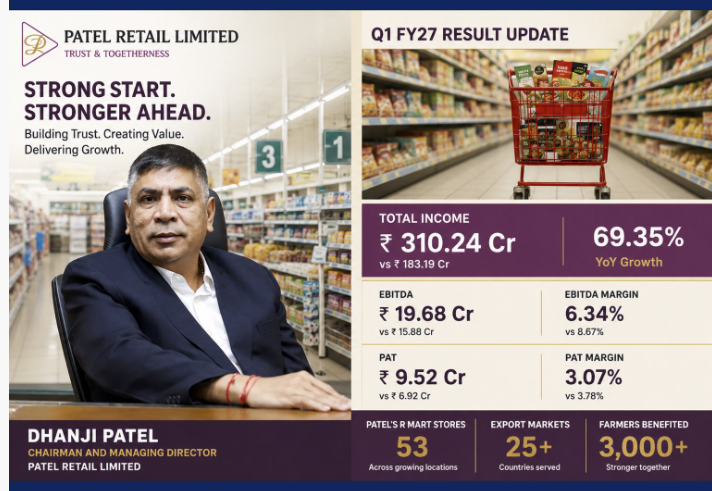
₹310.24 crore in Q1 FY27 total income. ₹19.68 crore EBITDA. ₹9.52 crore PAT. 53 Patel's R Mart stores. More than ₹1,000 crore in FY26 revenue. A listed company. Retail, food processing, private labels and exports spanning more than 25 countries.
The numbers tell the story of how far Dhanji Bhai has travelled. They do not, however, explain the man behind them.
I have always found Dhanji Bhai interesting precisely because he is almost the opposite of the increasingly familiar flamboyant Indian promoter. There is little theatricality about him, no great desire to turn the entrepreneur into the brand and very little of the corporate swagger that often accompanies success. His manner is understated, his language is simple and his public communication is generally about the business, the customer, the team and the next milestone.
Yet underneath that quiet exterior is a remarkably determined entrepreneur who has spent more than four decades taking risks, learning businesses from the ground up and steadily converting a single grocery shop into a retail, food processing and export enterprise.
Patel Retail's Q1 FY27 numbers provide the latest evidence of that momentum. Total income rose 69.35% year-on-year to ₹310.24 crore, EBITDA increased to ₹19.68 crore and PAT grew 37.43% to ₹9.52 crore. The company added its 51st store at Rasayani, its 52nd at Bapgaon, Bhiwandi, and another in July, taking the Patel's R Mart network to 53 stores.
But the more fascinating numbers are the ones that came much earlier in Dhanji Bhai's life: ₹100–150 a day and ₹25,000.
FROM ₹100 A DAY TO ₹1,000 CRORE
Dhanji Bhai's education ended after Class 8 in Dudhai, Kutch. At 16, he moved to Ambernath, where his elder brother was working in a grocery store, and joined him as a worker, earning around ₹100–150 a day. He was the son of a farmer, coming from a family that had enough food because his father grew what the family needed, but very little cash for education or even new clothes for festivals.
That early experience is important because it gives context to the retailer Dhanji Bhai eventually became. He understood the difference between having enough to live and having enough to aspire. He also learnt retail not in a classroom but behind a grocery counter, watching what customers picked up, what they ignored and what made them return.
Six years after arriving in Ambernath, he decided that working in somebody else's shop could not be his destination. In 1990, he and his elder brother Bechar Patel put together about ₹25,000 and opened their own grocery store under Patel Enterprises. It was a tiny beginning, but Dhanji Bhai was already looking beyond the counter.
The next leap came when he decided to move into the supermarket format. The investment was significantly larger, so the brothers put in their savings and borrowed from friends. For someone who had started with ₹25,000, it was a serious risk. Dhanji Bhai's own explanation of that decision is wonderfully simple: “Success lies on the other side of the risk.”
That sentence captures much of his entrepreneurial journey, although there is an important qualification. Dhanji Bhai is a risk-taker, but he is not a gambler.
THE QUIET RETAILER WITH A CALCULATED STREAK
This is perhaps the most interesting contradiction in Dhanji Bhai's personality. The man who was willing to borrow money to open his first supermarket is also the man who insists on understanding a market before making a significant bet.
Patel Retail's recent management commentary reflects that discipline. The company has emphasised researching a product, understanding distribution, testing customer acceptance and then scaling it rather than rushing into every new opportunity. Remarkably, the company has said that none of its stores had been shut and that it had not discontinued a product after introducing it.
That tells us something about how Dhanji Bhai thinks. He is prepared to take the risk, but once he takes it, he wants to understand how to make it work.
It is a very different entrepreneurial temperament from the “move fast and figure it out later” school of expansion.
Dhanji Bhai appears to prefer understand, commit, build and stay the course.
THE FIRST CONTAINER WAS RAISINS
One of my favourite anecdotes from Dhanji Bhai's journey is not about the IPO or the size of Patel Retail today. It is about his first export.
It was a container of raisins.
The man who had started behind a grocery counter had decided to enter exports without a formal background in international trade. He did not have an MBA or years of export experience. He had to figure out documentation, logistics and the mechanics of international business as he went along. That first container of kishmish became the beginning of an export business that has since grown into a significant vertical, with Patel Retail now serving more than 25 countries.
The anecdote is quintessentially Dhanji Bhai because it demonstrates his instinct for learning by doing. He did not wait until he had mastered exports to enter exports. He entered, learnt the process and then built the capability around it.
Today, the export business is reported to have grown into a ₹500-crore-plus vertical, spanning markets including the UK, Canada and Australia.
From one container of raisins to a major export business is a substantial journey. But Dhanji Bhai's approach remained the same: start with something you understand, learn what you don't, and build from there.
FROM DUDHAI TO THE FACTORY
There is another particularly satisfying loop in the story.
The boy who left Dudhai eventually returned to his village not simply as a succes
sful entrepreneur but as a manufacturer. Patel Retail established its first processing facility in Dudhai in 2016, followed by another facility in 2019. The move into processing gave the company greater control over sourcing, quality, product development and private labels.
For Dhanji Bhai, however, the connection to agriculture is more than a supply-chain strategy.
He grew up in a farming family. He knows what it means to grow food and still have very little cash. That background has influenced Patel Retail's approach to direct sourcing from farmers and supporting them through procurement and farming practices. The company says more than 3,000 farmers have benefited from this ecosystem.
There is therefore a natural arc to his journey: from farmer's son, to grocery worker, to retailer, to food processor and back to the farmer through an integrated business.
COVID DID NOT CREATE THE IDEA. IT CREATED THE URGENCY
The pandemic brought another revealing Dhanji Bhai anecdote.
Patel Retail had already been considering a grocery app, but the initiative had not moved at the required pace. COVID suddenly changed the customer's behaviour and made home delivery essential. The company accelerated the app and began delivering groceries to customers who could no longer shop in the traditional way.
Dhanji Bhai later described the pandemic as a “blessing in disguise” because it forced the business to accelerate something it had already been contemplating.
That response is consistent with his broader approach to disruption. He does not seem particularly interested in technological novelty for its own sake. If the customer's behaviour changes, the business must change with it. The technology is simply the means.
THE FOUR-KILOMETRE RETAILER
Dhanji Bhai's understanding of neighbourhood retail is equally practical.
Patel's R Mart is built around the idea of serving the customer close to home, with the company studying catchment, local demand, customer preferences and the potential of each market before selecting locations. The store is not simply another dot on an expansion map; it is intended to become the neighbourhood grocery destination.
That thinking also explains the company's emphasis on a cluster-based network. Instead of scattering stores indiscriminately across the country, Patel Retail has concentrated its growth around the Mumbai Metropolitan Region and adjoining markets, where it can build density, improve supply-chain efficiency and understand customers better. Dhanji Bhai has repeatedly described the objective as building a strong, scalable and customer-focused network.
There is nothing particularly glamorous about this strategy. It is simply good old-fashioned retail discipline: know the customer, know the catchment and make the store work.
THE GURU WHO BECAME PART OF THE JOURNEY
Perhaps the most revealing recent story about Dhanji Bhai has little to do with financial performance.
It concerns the late retail veteran S. C. Mishra, whom Dhanji Bhai describes as his guru.
He first met Mishraji in the early 2000s and credits him with shaping much of his understanding of retail. At a tribute gathering on Mishraji's second death anniversary, Dhanji Bhai spoke about his journey from one kirana store to more than 50 stores and the IPO.
But what made the story personal was his explanation of why he was speaking about his journey at that particular gathering. It was a promise he had made to Mishraji. Every milestone, he said, had been a step towards fulfilling that promise.
For a promoter who had just taken his company public, that is a remarkably personal way of looking at an IPO.
The listing was not merely a financial milestone.
It was part of a promise.
50 STORES WAS A MILESTONE. 53 IS STILL JUST THE BEGINNING.
When Patel Retail reached 50 Patel's R Mart stores, Dhanji Bhai addressed store managers across the network. His message was less about celebrating a number and more about what came next: customer experience, operational excellence, efficiency and a shared vision. He reminded the team that 50 stores was a milestone, but also “just the beginning.”
That mindset is visible again in his latest update. The 51st store opened at Rasayani, the 52nd at Bapgaon, Bhiwandi, and another followed in July, taking the network to 53. In Q1 FY27, total income grew 69.35% to ₹310.24 crore, while PAT increased 37.43% to ₹9.52 crore.
PATEL RETAIL: THE NUMBERS TODAY
|
Metric |
Latest figure |
|
FY26 Revenue from Operations |
₹1,048.33 crore |
|
FY26 Total Income |
₹1,059.29 crore |
|
FY26 PAT |
₹39.05 crore |
|
Q1 FY27 Total Income |
₹310.24 crore |
|
Q1 FY27 EBITDA |
₹19.68 crore |
|
Q1 FY27 EBITDA Margin |
6.34% |
|
Q1 FY27 PAT |
₹9.52 crore |
|
Q1 FY27 PAT Growth |
37.43% |
|
Patel's R Mart stores |
53 |
|
Export markets |
25+ countries |
|
Farmer beneficiaries |
3,000+ |
The numbers are impressive, but they are not the reason Dhanji Bhai's story is interesting.
THE EXACT OPPOSITE OF THE LOUD PROMOTER
In an era when promoter personalities increasingly become part of the brand, Dhanji Bhai remains remarkably understated. He is not selling a lifestyle. He is not trying to become a celebrity entrepreneur. He is not particularly interested in making himself the story.
And yet, his life is the story.
He came to Ambernath as a teenager, worked behind a grocery counter, saved and borrowed to start his own shop, took the risk of opening a supermarket, learnt exports through a container of raisins, moved backwards into food processing, built relationships with farmers, embraced digital commerce when COVID changed the rules and eventually took his company to the stock market.
The progression looks almost simple when written down. It certainly wasn't lived that way.
What connects the chapters is not flamboyance or charisma. It is consistency.
Dhanji Bhai has built his business by repeatedly taking the next logical risk, learning from it and then strengthening the organisation around it.
THE RETAILER WHO NEVER FORGOT THE COUNTER
That may ultimately be the most authentic thing about Dhanji Bhai.
The listed company, the processing plants, the exports, the private labels and the growing retail network are all very different from the grocery store where he started. But the instinct remains remarkably similar.
Look at the customer.
Understand what the customer needs.
Give the customer value.
And make sure the customer comes back.
It is a simple retail philosophy, but perhaps the most difficult one to execute consistently.
Today, Dhanji Bhai is building a much larger enterprise, with ambitions that extend well beyond the current 53-store network and into new markets, private labels, food processing and exports. Patel Retail has said it is targeting more than 75 stores in FY27 as it expands beyond its traditional MMR base into wider Maharashtra and Western India.
But I suspect Dhanji Bhai will continue to approach that ambition in much the same way he approached his first store.
Not with noise.
Not with theatrics.
Just with a clear understanding of the customer, a calculated appetite for risk and the patience to build.
From ₹100 a day to ₹1,000 crore-plus. From one grocery counter to a listed enterprise. From one container of raisins to a global export business.
The numbers are extraordinary.
But the most remarkable thing about Dhanji Bhai may be that, somewhere beneath all those numbers, the grocery-store worker is still thinking like a retailer.


comments


Other categories
Recent Comments