


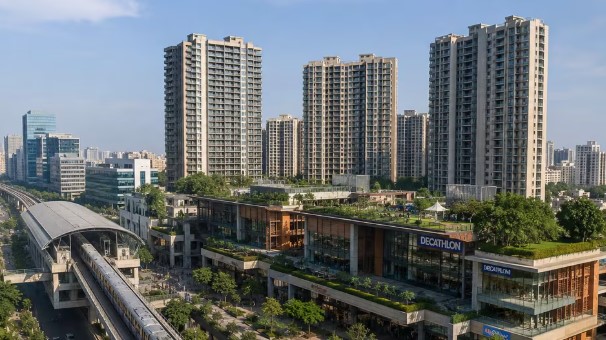
Delhi MPD 2047: Effective implementation will be key to making it a success, enabling Delhi to accommodate urbanisation and attract investments, say experts
Delhi’s real estate map could be on the cusp of a major reset. With Lieutenant Governor Taranjit Singh Sandhu approving the Delhi Master Plan 2047 on August 12, the capital has laid out its blueprint for accommodating a population expected to approach 32 million by 2047, and the nearly 4 million additional homes that could be needed along the way.
Delhi’s real estate map could be on the cusp of a major reset. With Lieutenant Governor Taranjit Singh Sandhu approving the Delhi Master Plan 2047 on August 12, the capital has laid out its blueprint for accommodating a population expected to approach 32 million by 2047, and the nearly 4 million additional homes that could be needed along the way.
What has happened?
Delhi Lieutenant Governor Taranjit Singh Sandhu approved the Delhi Master Plan 2047 on August 12. The plan will now be sent to the Ministry of Housing and Urban Affairs (MoHUA) for final approval and subsequent notification.
Sandhu said the new Master Plan will lay down a roadmap "for sustainable and inclusive urban growth, with greater Ease of Doing Business, Ease of Living, and a cleaner, greener capital for all. Delhi has a pivotal role to play in shaping this journey."
This reform aims to reduce procedural delays and enable faster project approvals, he said.
The DDA had been working on MPD 2041 after the expiry of MPD 2021, which has now been renamed 'MPD 2047'. The first Master Plan for Delhi was promulgated in 1962 under the Delhi Development Act of 1957, followed by the Master Plans of 2001 and 2021. These plans were prepared for 20-year prospective periods and provided a framework for the national capital's planned development.
This Master Plan is important because it is a long-term roadmap for a city’s growth, setting out the broad framework for population expansion, housing, land use, transport, infrastructure and community facilities. It helps determine how limited urban land can be used to accommodate future development. For Delhi, the plan comes at a time as the capital faces a growing shortage of affordable housing, even as the NCR, including Noida and Gurugram, continues to expand.
Key proposals on urban housing, DMRC, infrastructure and green spaces
Increase affordable housing supply in the Capital
To develop the national capital over the next 20 years, the MPD is likely to increase housing supply under the Transit-Oriented Development (TOD) policy, which allows the construction of high-rise buildings along metro and rail corridors.
"With Delhi's population projected to grow significantly by 2047, under the TOD policy in the 10 years, around 17 lakh dwelling units will be developed. Large-scale development of sectors in the greenfield areas of the city using the model of land pooling will be part of the new MPD," sources were quoted by PTI as saying.
In July, DDA opened the application for Developer Entity for its TOD policy. Its corridor-based approach opens up an area of 207 sq km, 500 metres on either side of Metro corridors and a 500-metre radius of RRTS or railway stations, primarily for provisioning of affordable housing. To further bridge the gap in dwelling units, residential high-rises in the 250-metre area on either side of Urban Extension Road II may be included in the MPD 2047.
Amendments to Unified Building Byelaws 2016 to simplify building plan approval process
In its meeting, chaired by Sandhu, the Delhi Development Authority (DDA) approved amendments to Unified Building Bye-Laws (UBBL)-2016 to simplify and fasten the building plan approval process.
The changes seek to de-link the requirement of obtaining prior no-objection certificates from the Delhi Pollution Control Committee, Chief Inspector of Factories, Delhi Jal Board and Forest Department for obtaining building permits, Hindustan Times newspaper reported.
Under its Land Pooling Policy, wherever there is a right-of-way of 30 metres or above, DDA will develop the road network, he added.
Amit Goyal, Managing Director of India Sotheby's International Realty said that the MPD 2047 finally gives Delhi a future-ready framework to work with, and the parallel move to ease the Unified Building Bye-Laws, cutting down NOC requirements, is a genuinely welcome first step for ease of doing business here.
The proposal allows for commercial construction in 70 villages on the edges of the Capital
According to Hindustan Times newspaper, another significant change will be in 70 villages on the city’s periphery through a Green Development Area (GDA) framework, allowing regulated commercial and institutional activity in areas where such development was earlier restricted.
These will include all 70 villages on the outskirts or periphery of Delhi, including Tikri Kalan and Mitraon Dhansa, as well as areas with farmhouses such as Mehrauli, Chhatarpur, and Satbari.
The GDA framework, which was detailed in the earlier 2041 plan brings together around 70 villages falling in the Green Belt and Low-Density Residential Area (LDRA) under a common planning framework. Of these, 47 were earlier governed by rules that restricted new residential and commercial construction, and 23 didn’t, the newspaper said.
Now, the new plan has paved the way for commercial development in all 70 villages along the periphery of Delhi with Gurugram and Noida-like vertical development, allowing higher Floor Area Ratio (FAR), the newspaper quoted an official aware of the matter as saying.
Permits reconstruction and redevelopment of old two-storey DDA units
The Master Plan also proposes a uniform policy for the redevelopment of old two-storey residential units built by DDA on individual plots in older housing schemes (such as Naraina Vihar) and extending it across all similarly placed schemes in Delhi.
"Developed under MPD-1962, several old DDA housing schemes consist of built-up two-storey units on individual plots that are over 50 years old and structurally deficient. While vacant residential plots have clear redevelopment guidelines under prevailing MPD norms, built-up two-storey units lacked a uniform framework," DDA said.
With the approval, built-up two-storey units are now granted redevelopment rights on par with vacant residential plots, DDA said.
Ban on concrete structures in the Yamuna O zone
The DDA also banned the construction of any concrete structure in the core area of the Yamuna floodplain. In the remaining area, which will be part two, only recreational activities will be allowed.
DDA has revealed details of the Master Plan yet, and it is unclear how the O zone will be demarcated. The draft MPD-2041 had proposed that the Yamuna floodplain – a low-lying riparian zone with a 4% annual probability of flooding and designated as O-Zone by successive master plans – would be included in the city’s database of green-blue infrastructure, the paper said.
Another major decision concerned 19.63 hectares of land in the Narela Sub-City of Zone P-I. DDA approved its change in land use from “recreational” and “public and semi-public” to “transportation” for development of a metro depot for the Rithala-Kundli corridor.
The proposed extension of the Delhi Metro’s Red Line from Rithala to Kundli is expected to connect north-west Delhi, Rohini and Narela with areas of Haryana.
Similarly, a 24,400 sq metre plot adjacent to the Sarojini Nagar residential area has been approved for a change of use from transportation (rail circulation) to residential use. Public notices will be issued for objections and suggestions. Three plots at Copernicus Lane, measuring 8,494.35 sq metres and allotted by the Land and Development Office to Bharatiya Vidya Bhavan, were approved for a change in use from residential to public and semi-public.
According to Ankur Jalan, CEO, Golden Growth Fund, the creation of additional housing supply within Delhi can help moderate the pressure on surrounding NCR markets. For developers, the policy direction creates greater opportunities to invest in redevelopment, premium and mid-income housing, while supporting a more efficient urban economy.
Swift approval of MPD 2047 important
“The true value of the Master Plan for Delhi lies in its swift approval and formal notification by the Union Ministry of Housing and Urban Affairs,” said Ankita Sood, National Director – Research, Knight Frank India.
Effective implementation, timely approvals, and matching infrastructure across mobility, utilities and civic amenities will be key for achieving the objectives of the plan. A calibrated execution can enable Delhi to accommodate urbanisation, attract investment and create a more competitive, sustainable and liveable capital city, said Ankur Jalan.


comments


Other categories
Recent Comments