


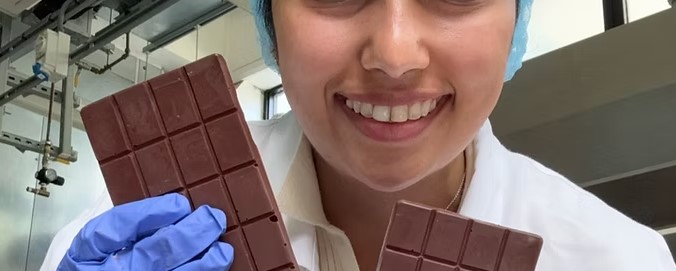
The University of Reading has created a chocolate bar made entirely from British ingredients, including cocoa grown in Berkshire, to mark its centenary year.
Named the Reading 100 Chocolate Bar, the product was developed by food security master’s student Maha Khan, who harvested, fermented and processed cocoa grown at the university before producing the finished chocolate in its Department of Food and Nutritional Sciences.
The project demonstrates that cocoa can be grown and processed in the UK, while also highlighting the importance of the global supply chains that underpin the chocolate industry.
The UK chocolate market is worth £10.4 billion but remains entirely dependent on imported cocoa. The university said this reliance demonstrates the importance of international food trade to farmers, consumers and economies around the world.
Khan said: “It has been amazing to follow the entire chocolate-making process, from pod to bean to bar, without leaving Reading. This British bar of chocolate highlights the precarious nature of our food supplies. Cocoa plants are very sensitive to changes in temperature and rainfall, and climate change is already causing problems in countries that produce most of the world's cocoa.”
Khan added that protecting different cocoa varieties will be important in helping farmers develop plants capable of withstanding a changing climate.
The cocoa used in the bar was grown at the university's International Cocoa Quarantine Centre in Berkshire, which houses more than 300 types of cocoa plant and handles 97% of the world's international movement of cocoa plants.
The climate-controlled centre is designed to prevent pests and diseases spreading between cocoa-growing regions, while also providing researchers with an environment in which to study different varieties.
Professor Carol Wagstaff, director of AgriFood Futures at the University of Reading, said: “The UK chocolate industry rests on a supply chain that starts thousands of miles away in the tropics of Africa, South America and Asia. A resilient global market is crucial to the many smallholder farmers who underpin the industry and find themselves farming in some of the regions most exposed to risks from climate change, as well as to chocolate makers and chocolate lovers in the UK.”
Wagstaff cautioned that while local sourcing can bring benefits, international food trade also has an important role to play in supporting communities and food security.
The project also showcased the processing required to transform cocoa beans into a finished chocolate product.
Cocoa pods from the university's collection would normally be removed without being used, but were instead harvested for the Reading 100 project. The beans were extracted from the pods, fermented, dried and roasted before being crushed and ground into cocoa powder using industry-standard equipment.
Khan then combined the cocoa with British-grown sugar and milk before heating, shaping and forming the mixture into the finished chocolate bar.
The university said the Reading 100 Chocolate Bar is one of only a small number of chocolates believed to have been made using cocoa grown in Britain.
The first documented example dates back to 1932, when Rowntree's produced a bar using cocoa grown in a glasshouse at its headquarters in York and gifted it to the then six-year-old Princess Elizabeth.
More recently, cocoa grown at the Eden Project in Cornwall has been used by local craft chocolate maker Chocolarder. The Eden Project's cocoa plants were also sourced through the University of Reading.
The Reading 100 Chocolate Bar forms part of the University of Reading's centenary celebrations throughout 2026, which are highlighting a century of research spanning areas including food, farming and climate science.


comments


Other categories
Recent Comments